- Details
- Category: Origins & History
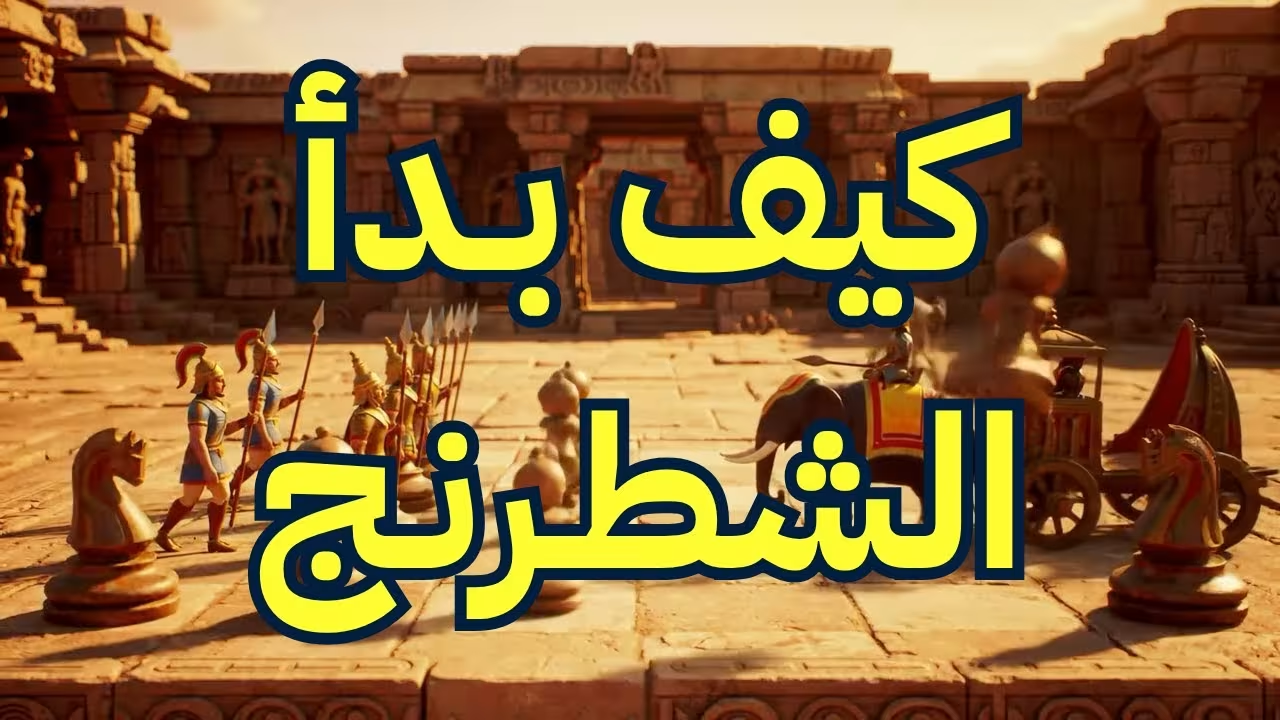
Chess isn't just a game; it's a profound narrative woven into the fabric of human history. Across 64 squares, it mirrors the art of war, the depth of strategy, the beauty of art, and the raw power of intellect. For over 1500 years, this venerable game has showcased an unparalleled ability to evolve and adapt, transcending empires, linguistic barriers, and cultural divides. It is, unequivocally, the "game of immortality." This is a saga of an idea that journeyed across time and space, transforming with each civilization that embraced it, yet retaining its core essence as a cerebral duel between two minds.
How did an ancient war game, born in the palaces of India, manage to cross the Silk Road and vast deserts, be adopted by the Persian Empire, then refined by scholars and poets during Islam's Golden Age? How did it undergo a radical revolution in its rules during the European Renaissance, ultimately becoming a globally unified mental sport governed by international bodies and played by hundreds of millions online?

- Details
- Category: Origins & History
Imagine a world where the very fabric of communication, commerce, and consciousness is constantly being rewoven. That's not a distant future; it's the ongoing story of the Internet, a phenomenon far grander than mere technology. Born from the crucible of Cold War anxieties, it began as a decentralized experiment in resilience, a desperate bid to ensure communication continuity in a doomsday scenario. Yet, this military imperative unexpectedly blossomed into a global platform, an open canvas where human ingenuity, not centralized control, truly thrived.
Today, we stand at another pivotal juncture. The Internet, having reshaped our daily lives from academic halls to every pocket, is once again on the cusp of a radical transformation. We're moving beyond mere speed upgrades or feature additions, venturing into an era where the digital realm doesn't just overlay our physical world but deeply intertwines with it. This journey is not a simple linear progression but a complex interplay of philosophical visions, geopolitical pressures, and relentless human aspiration for connection and innovation.
This article delves into that incredible saga, tracing the Internet's complex evolution from its embryonic origins—a blend of abstract academic dreams and urgent military needs—through its explosive growth into a global public utility, and finally, peering into the horizon of its future forms: Web3, the Metaverse, AI, and 6G connectivity. It’s a narrative that reveals not just technological marvels but also profound shifts in how we interact, create, and perceive reality.
- Details
- Category: Origins & History
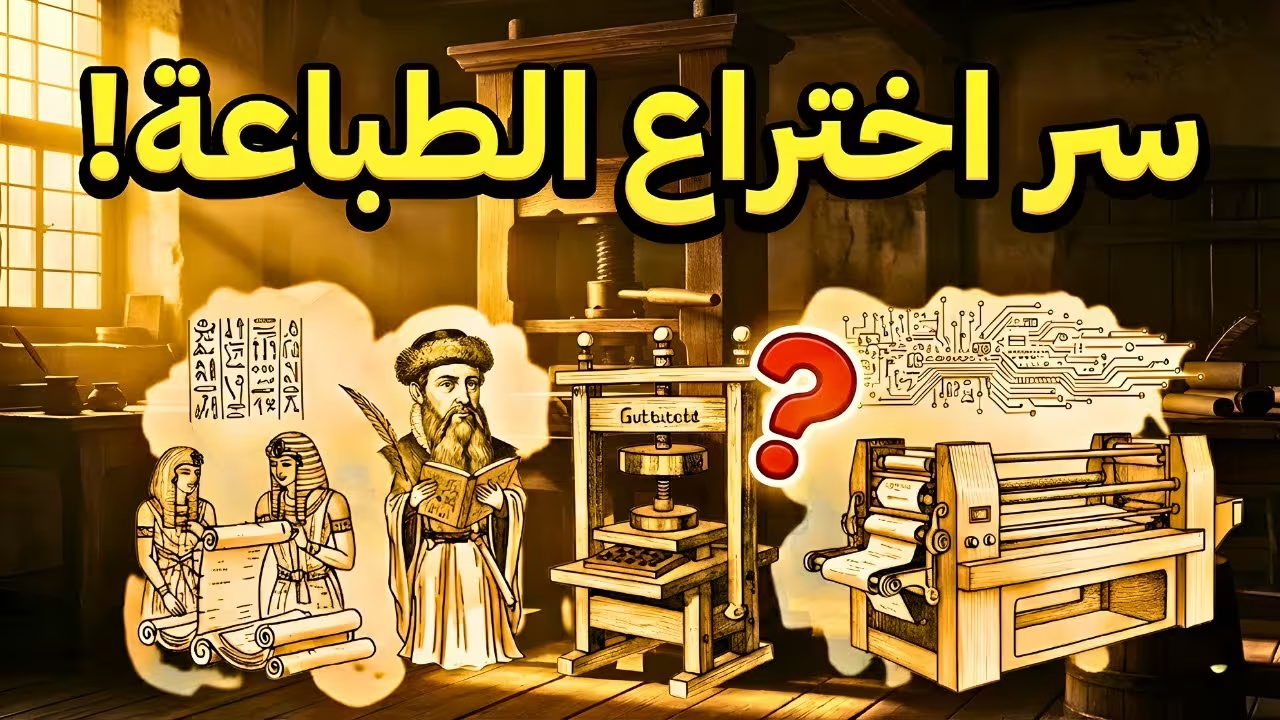
Imagine a world where knowledge is a whispered secret, painstakingly copied by hand, each word a treasure reserved for the elite. A world where an idea, once born, struggles to cross the city walls, let alone oceans. For millennia, this was the human reality. Our journey through "The Epic of Word and Machine" isn't merely a technological timeline; it's a profound narrative of humanity's ceaseless quest to replicate, share, and ultimately, liberate information from the confines of time and space.
From the humble clay seals of Mesopotamia, which marked ownership and validated transactions, to the revolutionary movable type of Bi Sheng and Gutenberg, printing has consistently served as a mirror reflecting our deepest desires: to communicate, to preserve, and to connect across generations. Each innovation, seemingly small in its moment, chipped away at the barriers of scarcity, transforming abstract thoughts into tangible artifacts accessible to ever-widening circles of people.
Today, as we stand on the cusp of an entirely new frontier – one where printing extends beyond ink on paper to sculpt living tissues and construct entire homes – it's crucial to pause and appreciate the epic journey that brought us here. This isn't just a story about machines; it's a testament to the human spirit's ingenuity, resilience, and the relentless drive to redefine what's possible, fundamentally altering the very fabric of our civilization.
- Details
- Category: Origins & History
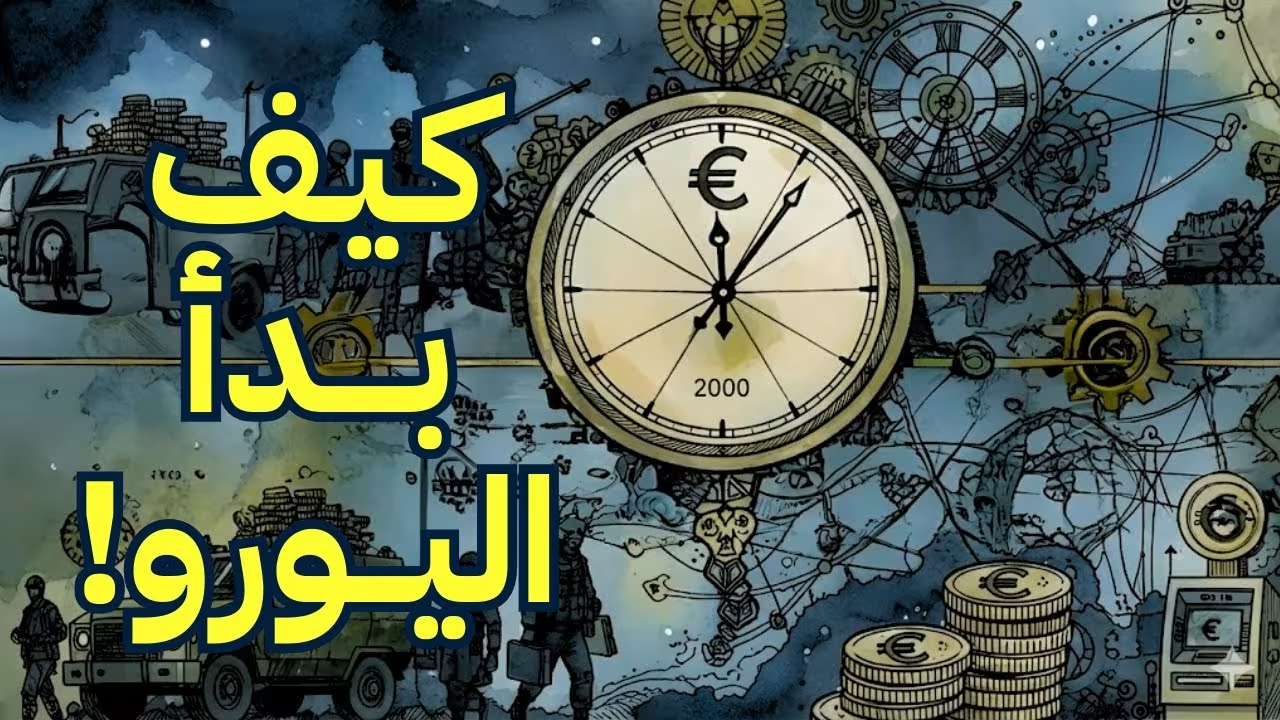
In the grand tapestry of modern history, few endeavors stand out as boldly as the creation of the Euro. It wasn't merely a technical decision to swap national currencies; it was a profound political act, a leap of faith designed to bind nations together, to foster peace and prosperity on a continent scarred by centuries of conflict. Conceived in the aftermath of two World Wars, the Euro aimed to transform a fragmented marketplace into a cohesive economic powerhouse, making war not just unthinkable, but economically improbable.
This ambitious project, now a quarter-century old, has traversed a landscape filled with both triumphs and tribulations. From its complex birth in the late 20th century to navigating global financial crises and geopolitical upheavals, the Euro has become far more than just a medium of exchange. It is a symbol of European identity, a testament to collective will, and a constant experiment in balancing national sovereignty with supranational integration.
Join us as we journey through the Euro's fascinating past, its present challenges, and its future aspirations – from the analog origins to the digital horizons, exploring how this single currency has reshaped Europe and continues to adapt to a rapidly changing world.
- Details
- Category: Origins & History
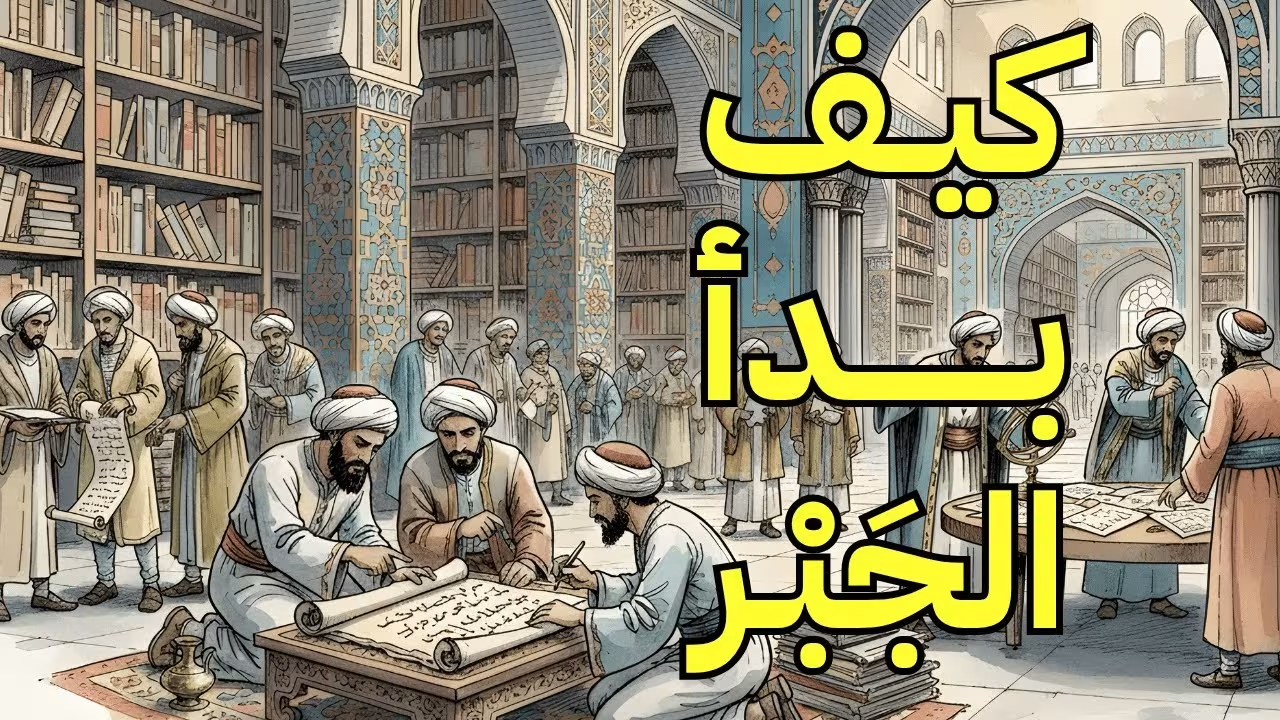
When we talk about algebra today, we often picture complex equations, variables, and abstract concepts that form the bedrock of modern mathematics. But have you ever paused to consider where this powerful branch of knowledge truly began? The question of algebra's “inventor” isn't merely about pinpointing a single discovery; it’s about understanding a profound shift in intellectual thought – the systematic establishment of an entire scientific discipline.
For centuries, mathematical ideas related to solving problems existed across various civilizations. The Babylonians tackled quadratic equations, and the Greeks, through figures like Diophantus, explored number theory with nascent symbolic notation. Yet, these were often collections of problems and specific techniques. The leap from a collection of solutions to a unified, self-contained science required something more. It demanded a foundational methodology, a universal language, and a clear purpose. This is where Muhammad ibn Musa al-Khwarizmi, the brilliant polymath of the Islamic Golden Age, steps into the spotlight.