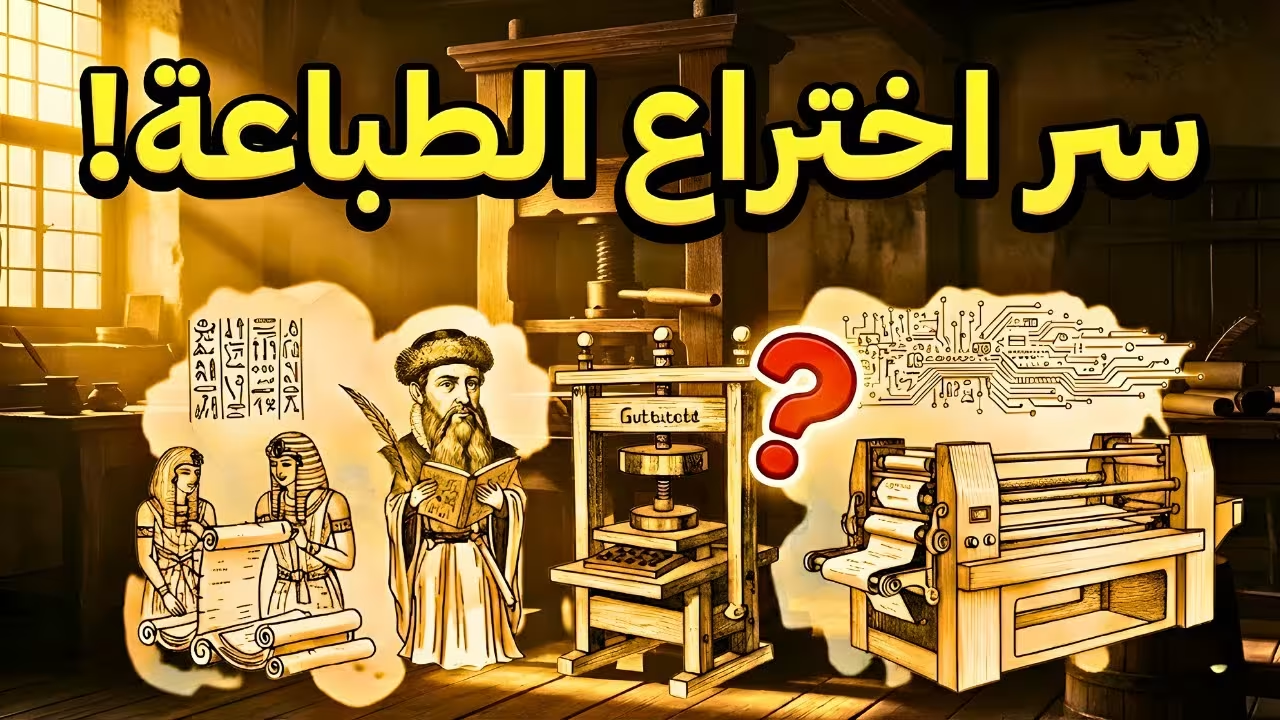
Imagine a world where knowledge is a whispered secret, painstakingly copied by hand, each word a treasure reserved for the elite. A world where an idea, once born, struggles to cross the city walls, let alone oceans. For millennia, this was the human reality. Our journey through "The Epic of Word and Machine" isn't merely a technological timeline; it's a profound narrative of humanity's ceaseless quest to replicate, share, and ultimately, liberate information from the confines of time and space.
From the humble clay seals of Mesopotamia, which marked ownership and validated transactions, to the revolutionary movable type of Bi Sheng and Gutenberg, printing has consistently served as a mirror reflecting our deepest desires: to communicate, to preserve, and to connect across generations. Each innovation, seemingly small in its moment, chipped away at the barriers of scarcity, transforming abstract thoughts into tangible artifacts accessible to ever-widening circles of people.
Today, as we stand on the cusp of an entirely new frontier – one where printing extends beyond ink on paper to sculpt living tissues and construct entire homes – it's crucial to pause and appreciate the epic journey that brought us here. This isn't just a story about machines; it's a testament to the human spirit's ingenuity, resilience, and the relentless drive to redefine what's possible, fundamentally altering the very fabric of our civilization.
The Eastern Dawn: Where the Word First Broke Free
While common narratives often spotlight European ingenuity, the true genesis of printing traces back millennia, blossoming in the East long before Gutenberg's press ever inked a page. This journey reveals not only technological prowess but also how cultural contexts and societal needs often serve as the fertile ground for groundbreaking innovation.
From Clay Seals to Woodblock Wonders
Long before paper or ink as we know it, humans sought ways to replicate images and texts. The Sumerian and Elamite civilizations of Mesopotamia, as early as the fourth millennium BCE, utilized cylindrical seals. These intricate tools were rolled across soft clay to produce recurring patterns, document commercial transactions, and certify origins [1]. While rudimentary, these seals planted the fundamental seed: the concept of repeating an image or text without manual re-drawing each time [1]. It was a simple yet profound insight that would echo through history.
The real leap, however, came in China during the Tang Dynasty (618-907 CE). The primary catalyst was the burgeoning spread of Buddhism. Copying sacred texts, or sutras, was considered an act of devotion, believed to accrue good "karma" [2]. This spiritual impetus fueled the development of woodblock printing, a technique involving carving an entire page of text or images in relief, in reverse, onto a wooden block, which was then inked and pressed onto paper or cloth [2]. The sheer dedication required for this method underscores the cultural value placed on the dissemination of religious knowledge. The most compelling material evidence of this early supremacy is the "Diamond Sutra" from Dunhuang, dated precisely to May 11, 868 CE, making it the world's oldest complete, dated printed book [4]. This discovery utterly dismantles the notion that printing originated in Europe and firmly establishes China's long-standing publishing and distribution infrastructure centuries before the European Renaissance.
Bi Sheng's Vision: The Genesis of Movable Type
While woodblock printing was highly effective for mass-producing static texts, it lacked flexibility. A single carving error meant re-carving the entire block. The solution arrived in China during the Northern Song Dynasty, around 1041 CE, thanks to an ingenious craftsman named Bi Sheng [5]. Bi Sheng grasped that the secret lay in deconstructing text into its fundamental units: individual characters. He invented movable type by crafting individual characters from sticky clay, carving them thin like coin edges, and then firing them to harden them into durable ceramic [5].
The process for typesetting involved arranging these ceramic characters within an iron frame on a plate coated with a chemical mixture of pine resin, wax, and paper ash. Upon heating, the mixture would soften, securing the characters, which were then pressed with a smooth wooden board to create an even surface, ready for printing. Despite its brilliance, Bi Sheng's ceramic type faced challenges, primarily its fragility and the complexity of the Chinese language, with its thousands of ideograms. This made typesetting and searching for characters significantly slower compared to alphabetic languages, ensuring woodblock printing remained dominant for centuries [5].
Wang Zhen's Mechanical Touch
Innovation didn't halt with Bi Sheng. In 1297 CE, the government official Wang Zhen pushed the technology further by replacing Bi Sheng's fragile ceramic type with wooden movable type. Wood was more durable, easier to carve, and less prone to breakage [6]. To address the logistical nightmare of managing thousands of Chinese characters, Wang Zhen devised "rotary tables" – large, rotating cylinders where characters were organized by phonetic rhymes [6]. A compositor could sit between two tables and rotate them to swiftly access the required characters, dramatically increasing typesetting speed and efficiency. This mechanical ingenuity foreshadowed later European developments, demonstrating a continuous drive for improvement in the East.
Korea's Bronze Revolution: Preceding Gutenberg
The pivotal role of Korea in the global history of printing is often overlooked. During the Goryeo Dynasty, Koreans not only adopted Chinese printing techniques but profoundly advanced them. Around 1234 CE, Koreans invented metal movable type (made from bronze), predating Gutenberg by over two centuries [3]. This wasn't merely an incremental improvement; it was a game-changer. Metal type offered unparalleled durability compared to wood, making it ideal for the state's need to print limited quantities of diverse titles. This technological lead fundamentally discredits the idea that metal type originated in Europe, firmly placing its origins in Asia. The "Jikji," printed in 1377 CE at Heungdeok Temple, stands as the oldest existing book printed with metal movable type in the world [3], a silent testament to Korea's groundbreaking contribution. These ideas, facilitated by trade routes like the Silk Road, subtly influenced later endeavors in the West.
Gutenberg's Revolution: When Mechanics Met Knowledge in the West
As printing techniques quietly evolved in the East, Europe remained locked in a "manual copying" era, where knowledge was a luxury, confined mostly to monasteries and wealthy patrons. Books were rare, precious commodities, each a monument to months or even years of painstaking scribal labor. It was in this intellectual drought, in Mainz, Germany, that Johannes Gutenberg emerged, sparking a revolution that would shatter the old order and unleash an unprecedented flow of information.
The Genius of Integration: More Than One Invention
It's a common historical misconception to credit Gutenberg with "inventing printing" from scratch. His true genius, refined through years of experimentation in Strasbourg and Mainz (c. 1440-1450 CE), lay in ingeniously assembling, adapting, and integrating several existing technologies into a cohesive, highly efficient mass production system [8]. Gutenberg didn't invent the wheel of printing; he engineered a revolutionary vehicle capable of democratizing knowledge.
His system was built on three pivotal innovations:
- The Screw Press: Gutenberg drew inspiration from the wine and olive presses common in European agriculture [9]. He cleverly adapted this mechanism to apply powerful, even mechanical pressure across the paper's surface, a significant improvement over the less consistent "hand-rubbing" methods used in the East. This press allowed for clear, rapid printing on both sides of a sheet, a critical step towards efficiency.
- Metal Alloy and Hand Mould: The secret to mass-producing consistent, durable type lay in Gutenberg’s specialized metal alloy, a precise blend of lead, tin, and antimony [10]. This alloy was ideal because it melted at low temperatures, flowed easily into moulds, and solidified quickly without shrinking, producing thousands of identical characters with extreme precision. He also developed the "hand mould," a revolutionary tool that enabled the rapid casting of type, making the production of interchangeable characters feasible on an industrial scale [10].
- Oil-Based Ink: Eastern water-based inks were suitable for wood, but they didn't adhere well to metal. Gutenberg formulated an oil-based ink (similar to artist's oil paints) that clung perfectly to his metal type, transferring sharp, durable images onto paper [10]. This seemingly small detail was crucial for the quality and permanence of his printed works.
The Gutenberg Bible, Betrayal, and the Blazing Trail
Gutenberg’s technological prowess culminated in his most ambitious project between 1452 and 1455 CE: the printing of the Gutenberg Bible. This masterpiece showcased astonishing artistic quality, meticulously mimicking the aesthetic of Gothic handwritten manuscripts on both vellum and paper [11]. Around 180 copies were produced, a feat previously unimaginable.
However, behind this triumph lay a personal tragedy. To fund his monumental undertaking, Gutenberg borrowed heavily from Johann Fust. When the expected returns were delayed, Fust sued him in 1455 CE, accusing him of mismanagement [7]. Fust won, seizing Gutenberg's printing press, equipment, and even the precious type moulds he had spent a lifetime perfecting. Fust, along with Gutenberg's skilled assistant, Peter Schöffer, took over the operation, reaping the commercial rewards while Gutenberg died in poverty and obscurity in 1468 CE, his story largely untold until later historical vindication [7].
The Spark Spreads: From Mainz to the World
Despite Gutenberg and his partners' initial attempts to guard their "trade secret," history intervened. The Sack of Mainz in 1462 CE, caused by a church dispute, scattered the city's printers and craftsmen across Europe [12]. They carried with them the "new art," effectively sowing the seeds of the printing revolution far and wide. Printing quickly spread to Italy, with Venice becoming a major publishing hub, leveraging its strategic position for book distribution via sea [12].
In England, William Caxton introduced printing in 1476 CE. More than just a printer, Caxton was a translator and editor. His decision to print books in the vernacular English (not just Latin) and publish literary works like Chaucer's "Canterbury Tales" was instrumental in standardizing the English language and solidifying its grammatical and spelling rules [9]. The printing press wasn't merely a reproducer of texts; it was a powerful homogenizer of language and a catalyst for national identity, preparing Europe for seismic cultural and political shifts.
The Tremors of Knowledge: Printing's Profound Impact on Society
If the invention of the wheel facilitated the movement of goods, the printing press enabled the unprecedented movement of ideas. It transformed information from a scarce luxury into a flowing current, reshaping economies, religions, sciences, and even the dark corners of human superstition.
Economic Engines and Urban Blooms
The printing press was far more than a cultural tool; it was a formidable economic engine. Contemporary economic research, particularly a study by Jeremiah Dittmar of the London School of Economics, provides compelling quantitative evidence [11]. Dittmar's work reveals a striking correlation: European cities that adopted printing early (in the late 15th century) grew approximately 60% faster between 1500 and 1600 CE than comparable cities that did not [11].
This accelerated growth wasn't solely due to the printing industry itself. Printing fostered "spillovers" – knowledge externalities that taught merchants about calculating interest, exchange rates, and bookkeeping (such as the double-entry system published in 1494 CE) [12]. This enhanced mercantile efficiency and boosted human capital. Port cities, in particular, benefited immensely, as the ease of water transport combined with the swift flow of information made them hubs of commercial innovation [11]. Critically, printing drastically reduced the cost of books, by two-thirds between 1450 and 1500 CE, making knowledge accessible to the burgeoning middle class, not just the nobility and clergy, thus creating new demand and a vibrant market [11].
The "Viral" Reformation: Religion and Politics Transformed
Perhaps the most immediate and profound impact of the printing press was on the Protestant Reformation. Before the press, criticisms of the Church remained localized and easily suppressed. But when Martin Luther posted his 95 Theses on the church door in Wittenberg in 1517, the equation changed. Luther’s treatises were printed and distributed with lightning speed across Germany and Europe [12]. Estimates suggest that between 1517 and 1520, over 300,000 copies of Luther’s works were printed, making him arguably the first "bestselling author" in history [12].
The printing press broke the monopoly of knowledge. It enabled individuals to read the Bible in their local languages (German, English, French) rather than solely in Latin, which only the clergy understood [9]. This shattered the Catholic Church's interpretive authority, leading to religious wars and geopolitical shifts that redrew the map of modern Europe [12]. Rulers and politicians quickly grasped the power of print, using it for political propaganda to garner popular support or discredit rivals, making "public opinion" a force to be reckoned with for the first time in history [12].
The Shadow Side: Superstition and Witch Hunts
The printing press was not merely an instrument of enlightenment; it was a double-edged sword. It accelerated the spread of misinformation and hatred with the same efficiency it propagated science. Recent studies (2024) from the Santa Fe Institute point to a direct causal link between the printing press and the proliferation of witch trials in Europe [12].
The infamous "Malleus Maleficarum" (Hammer of Witches), published in 1487, served as both a theoretical and practical guide for torturing and executing women accused of witchcraft [12]. Researchers found that the more new editions of the book were printed in a city, the higher the rate of witch trials and executions in that city and its surrounding areas [12]. The press transformed local superstitions, what researchers term "ideational diffusion," into a "truth" backed by the authority of the printed word, leading to the deaths of tens of thousands of innocents [12].
Scientific Unification: The Data Revolution
Before the printing press, scientists wrestled with "data corruption." Hand-copied astronomical tables, mathematical calculations, and anatomical diagrams were rife with errors that compounded with each successive copy [10]. The press provided standardized references. It enabled the production of identical copies of mathematical tables, precise anatomical drawings (like Vesalius's works), and maps [10]. This allowed scientists across different countries to rely on the same data, verify it, and collectively correct errors. The press also fostered scientific collaboration, paving the way for the Scientific Revolution of the 16th and 17th centuries, accelerating the exchange of discoveries and the rapid debunking of old theories (Copernicus, Galileo, Newton) [12].
Victims of Progress: Scribes and Ottoman Resistance
As with any disruptive technology, the printing press created losers and resistance [12]. Scribes and copyists, whose livelihood depended on manual transcription, faced an existential threat. Guilds of scribes and copyists resisted the change, with figures like Abbot Johannes Trithemius arguing in his 1492 book, "In Praise of Scribes," that manual copying was an act of devotion and that printed books were ugly, ephemeral, and prone to decay [12]. The irony, of course, is that Trithemius himself had to use the printing press to disseminate his arguments against it. This shift ultimately led to the decline of scribal professions, transforming them into specialized calligraphers for the elite [12].
In the Islamic world, particularly the Ottoman Empire, the introduction of printing with Arabic movable type was resisted for centuries [12]. Fears included the potential for textual corruption of the Quran and the loss of authority for religious scholars (ulama), who acted as guardians of knowledge. There was also concern for the massive guilds of copyists (thousands in Istanbul) who would face unemployment. This significant delay in adopting printing had long-term ramifications for scientific and economic development in the region compared to Europe [12].
What If? Printing's Alternative Histories & Peculiar Byways
The history of printing is not just a tale of progress; it's also a canvas for imagining alternate realities and a repository of the truly bizarre, revealing unexpected facets of human nature and ingenuity.
A World Without the Press: A Glimpse into a Different Future
Contemplating a world without Bi Sheng or Gutenberg is a thought experiment that underscores just how deeply intertwined our civilization is with print [12]. Without it, the "Dark Ages" might have lingered indefinitely. The Renaissance would likely have remained a limited, elitist phenomenon in Italy, never blossoming into a full-blown European cultural movement [12]. Classical knowledge, painstakingly "revived," would have remained trapped in monasteries and private libraries, never reaching the burgeoning middle class that fueled social change.
Religious and political power would have remained absolute. Martin Luther’s challenge to the Catholic Church would likely have been quashed as a local heresy, akin to earlier movements like the Hussites [12]. The Church would have retained its complete monopoly over information and the lives of people. Scientific discoveries, from Earth's rotation to Newton's laws, would have traveled agonizingly slowly via personal letters, prone to loss or oblivion for centuries [12]. The Industrial Revolution, too, would have been severely delayed without the rapid exchange of technical and engineering knowledge needed to build machines. Languages would have remained fragmented and unstandardized, with Latin retaining its exclusive status for the elite. Crucially, human memory itself would be far more fragile; a single library fire or invasion could obliterate vast swathes of human heritage, as there would be no distributed "backup" system for civilization's knowledge [12].
Beyond Ink and Paper: Printing's Peculiarities
The epic of printing isn't without its macabre and whimsical chapters, showcasing the strange depths of human obsession.
"The epic of printing isn't without its macabre and whimsical chapters, showcasing the strange depths of human obsession."
One of the most chilling, yet scientifically documented, phenomena is anthropodermic bibliopegy – the practice of binding books in human skin [12]. Harvard University famously confirmed one such book, a copy of Arsène Houssaye's "Des destinées de l'âme" (On the Destinies of the Soul), bound in the skin of a deceased mental patient by Dr. Ludovic Bouland in the 19th century, reportedly without consent [12]. Bouland himself noted inside the book, "A book about the human soul deserved to have a human covering." In 2024, Harvard announced the removal of the binding and respectful reinterment. Beyond scientific curiosity, some bindings were punitive, with books made from the skin of executed criminals like William Corder (1828) [12]. In a rare instance of voluntary donation, the thief James Allen requested his memoirs be bound in his own skin after his execution, as a gift to the man he attempted to rob, who had impressed Allen with his bravery [12].
Other curious uses abound: In 1977, Marvel Comics printed a special edition comic for the band KISS using blood-infused red ink, reportedly drawing blood from each band member and mixing it into the ink [12]. During the American Civil War, printing presses were so vital that small, portable "battlefield presses" were mounted on horse-drawn wagons to print military orders, maps, propaganda, and even camp newspapers, boosting morale amidst the chaos [12]. On the whimsical side, the world's smallest printed book is a Japanese work on flowers, measuring a microscopic 0.0291 x 0.0295 inches, requiring a powerful microscope to read [12]. Even iconic pop culture owes a debt to printing's quirks: the Hulk's original color was meant to be gray, but inconsistent printing processes led to varying shades, sometimes with a greenish tint. Stan Lee opted for green, finding it easier and more consistent to print, thus giving birth to the "Green Giant" [6].
The Third Revolution: 3D Printing and Beyond
If traditional printing liberated information and turned it into a commodity, the third revolution of printing, 3D printing, liberates matter itself. It transforms digital data into tangible physical objects, moving us from merely printing texts and images to constructing houses, living organs, and even customized food.
The Digital Genesis: Chuck Hull and the Pioneers
The modern story of 3D printing began in 1983 with Chuck Hull, an American engineer working with UV light to harden tabletop coatings [12]. A spark of insight struck him: "What if I could use this light to solidify thin layers of liquid plastic (photopolymer resin) on top of each other to build a three-dimensional object?" This conceptual breakthrough led to Stereolithography (SLA). Hull patented SLA in 1986 and founded 3D Systems in 1987, releasing the first commercial 3D printer [12]. This invention opened the floodgates for other transformative techniques:
- Selective Laser Sintering (SLS): Invented by Carl Deckard in 1988, SLS uses lasers to fuse powdered materials (plastics, metals) instead of liquid resins [12].
- Fused Deposition Modeling (FDM): Developed by Scott Crump (Stratasys founder) in 1989, FDM works by melting and extruding plastic filaments layer by layer. It's the most common technology in home 3D printers today [12].
- The RepRap Movement: With the expiration of key 3D printing patents around 2009, the "RepRap" (Replicating Rapid Prototyper) open-source movement emerged, dramatically reducing printer costs from thousands to hundreds of dollars and popularizing 3D printing in homes and schools [12]. This democratized manufacturing, putting the power of creation into the hands of many.
Beyond the Imagined: From Construction to Biology
3D printing has evolved from a rapid prototyping tool into a comprehensive manufacturing technology, reshaping entire industries [12].
Bioprinting: The Revolution of Living Organs
This is arguably the most ambitious and complex frontier: bioprinting. Scientists are no longer printing with plastic, but with "bio-ink" – suspensions of living cells and hydrogels [12]. The past few years (2024-2025) have seen monumental breakthroughs. Researchers at Northeastern University, for instance, in 2025, managed to develop flexible, biodegradable "hydrogel" materials that allow for the printing of delicate blood vessels, addressing the grand challenge of how to supply printed organs with blood [12]. Scientists have successfully printed prototypes of beating hearts (with living tissues) and liver tissues [12]. The ultimate goal is to print entire organs (kidneys, hearts) from a patient's own cells, ending the organ donor crisis and eliminating the problem of immune rejection, thus negating the need for immunosuppressant drugs [12]. In 2024, a patient successfully received a 3D-printed windpipe made from their own stem cells, marking a significant clinical first [12].
Printed Homes: Solving the Housing Crisis
In the construction sector, giant robots are now capable of "printing" entire concrete house structures. This offers unprecedented speed and cost-effectiveness. A 1200-square-foot house structure can be printed in under 24 work hours [12], reducing costs by 20-30% compared to traditional building methods, largely due to labor savings (up to 80%) and minimized material waste [12]. These homes often use recyclable and bio-based materials instead of conventional concrete. Projects like "BioHome3D" and affordable models for as little as $4000 are already emerging, promising solutions for housing shortages in developing nations and disaster zones [12].
The Future of Food: Digital Meats and Personalized Sushi
"Food of the future" is no longer science fiction. 3D printing has entered gourmet kitchens and industrial food production. Companies like "Redefine Meat" use printing to precisely mimic the fibrous texture of animal muscle and fat, producing stunning plant-based "steaks" that are now sold in European restaurants and the UK [12]. Forecasts predict massive growth in this market post-2025, with products becoming readily available in supermarkets [12].
In Tokyo, a revolutionary restaurant concept called "Sushi Singularity" (planned opening) plans to take personalization to an extreme [12]. Diners submit their biological data for analysis before arriving. The restaurant then 3D prints sushi pieces with precisely tailored nutrient pastes, integrating food with health data in a remarkable fusion [12].
4D Printing: Adding the Dimension of Time
The ambition doesn't stop at three dimensions. The future points towards 4D printing, where the fourth dimension is "time." Smart objects are printed that can change their shape or properties over time in response to external stimuli like heat, humidity, or light, without human intervention [12]. Imagine water pipes that automatically expand when water pressure increases to prevent bursting, or medical implants that grow with a child's body. This cutting-edge field merges materials science with printing, creating "smart materials" that redefine interaction with the physical world.
Watch the Full Discussion
Sources & References
Key Sources
- Article: Unique Impressions: The Mechanics and Creativity of Printmaking - Gilcrease Museum Online Collections
- China in 1000 CE - Song Dynasty China | Asia for Educators - Columbia University
- History of Printing Timeline
- Chapter 5. The Invention and Spread of Printing: Blocks, type, paper, and markets, contact - History of the Book
- Bi Sheng | Research Starters | EBSCO Research
- Timeline of the Printing Industry: 6th Century - Till Date - PrintXpand
- 7 Ways the Printing Press Changed the World - History.com
- How the Invention of the Printing Press Changed the World - Articles by MagellanTV
- Gutenberg Pioneers the Printing Press | Research Starters - EBSCO
- The History of Printmaking from Wood Blocks to the Digital Age - SNAP Gallery
- INFORMATION TECHNOLOGY AND ECONOMIC ... - Index of /
- Johannes Gutenberg's Printing Press: A Revolution In The Making Junior Division
View Full Bibliography
- History of printing - Wikipedia
- Before Paper | Paper, Leather, Clay & Stone - Online Exhibitions
- Printing Press - Invented, Gutenberg, Significance - History.com
- The Revolutionary Impact of the Printing Press | Coconote
- Unusual historical facts about the printing industry
- How one of humanity's most important inventions fuelled deadly witch hunts in Europe
- How a witch-hunting manual & social networks helped ignite Europe's witch craze | Santa Fe Institute
- How the Printing Press Helped in Shaping the Future - The Texas A&M University System
- How the Printing Press Reshaped Associations - Strategic Membership Solutions
- The Gutenberg Revolution: How the printing press shaped humanity and what it means for Al - Quocirca
- The Political Economy of Mass Printing: Legitimacy and Technological Change in the Ottoman Empire Metin M. Coşgel – University of Connecticut
- Alternative History: What If the Printing Press Had Never Been Invented? - Medium
- Alternate History – What would the world be like without Gutenberg - Prezi
- Let's Talk About Binding Books with Human Skin - VICE
- What is the status of the book bound in human skin at Harvard? - Ask a Librarian
- You Won't Believe What Was Used to Bind This Book in Harvard's Library - Magazine
- Anthropodermic bibliopegy - Wikipedia
- Our Story - 3D Systems
- Chuck Hull Invents Stereolithography or 3D Printing and Produces the First Commercial 3D Printer - History of Information
- Pioneers of Printing: Chuck Hull and the Beginning of 3D Printing - Drupa
- The Complete History of 3D Printing: From 1980 to 2023 - 3DSourced
- 3D Printing Milestones that Shaped the Past and Future - Uptive Manufacturing
- A breakthrough in bioprinting may soon lead to 3D-printed blood vessels and human organs - Northeastern Global News
- Designing blood vessels for 3D printed hearts | Stanford Report
- Revolutionising healthcare: bioprinting takes a leap forward in 2024
- The future of organ transplants: Xenotransplantation, 3D bioprinting and stem cells
- Woman given a new 3D-printed windpipe in a world-first | BBC Science Focus Magazine
- 3D-Printed Houses: 12 Top Examples | Built In
- 3D Printed Houses: Real Construction Costs Revealed in 2024 - Industrial Build News
- 3D Printed House Benefits and Challenges Explained - SOVOL
- The Future of Housing: 3D Printed house in 2024 - Kingroon
- Veganuary 2025: Redefine Meat in 'taste it to believe it' drive - Food and Drink Technology
- Greene King Debuts Redefine Meat's 3D-Printed Vegan Steak - Green Queen Media
- Press releases Archive - Redefine Meat
- 3D Printed Meat Market Size and YoY Growth Rate, 2025-2032
- Tokyo Restaurant Offers 3D-Printed Sushi Tailored to Your Health Needs - My Modern Met
- Open Meals uses your biology to 3D print custom Sushi for each individual diner using
- Researchers make breakthrough in bioprinting functional human heart tissue | ScienceDaily
- Evolution of bioprinting and current applications - PMC - PubMed Central
- New Media and Market Structure: Printing and Europe's Transformation After Gutenberg - American Economic Association
- New 3D bioprinting technique may improve production of engineered tissue | MIT News
- Missouri S&T Unveils Faster, Light-Based 3D Printing for Organs-on-a-Chip
- The Future of Organ Transplants: 3D Bioprinting and Beyond - Research Inventions Journals
- 3D-Printed Homes in 2025: How $400000 Houses Are Disrupting the Construction Industry
- 3D Printed Meat - Top Global Industry Trends in 2026
- 3D Printed Sushi Could Be the Food of Choice for Space Travelers - 3Dnatives
Conclusion: The Enduring Epic of Replication and Creation
From the ancient Sumerian clay seals that documented jar ownership to Bi Sheng's ceramic movable type attempting to tame the Chinese language, and from Gutenberg's press igniting religious and scientific revolutions to today's laser printers building heart cells and house walls, a singular thread weaves through this epic: humanity's eternal desire to replicate, to preserve, and to transcend.
The first printing revolution pulled the world from intellectual shadows into the light of knowledge, liberating minds from the scarcity of information. Now, 3D printing is transforming the world from centralized manufacturing to personal fabrication, freeing matter itself from the constraints of rigid molds. If Gutenberg granted us the power to "read" the world differently, 3D printing empowers us to "rewrite" its physical and biological matter. We are still in the opening chapters of this ever-unfolding book, writing itself with a "bio-ink" that evolves daily from oil to living cells. The journey of the word, from a whispered secret to a tangible, customizable creation, continues its profound and thrilling transformation.