
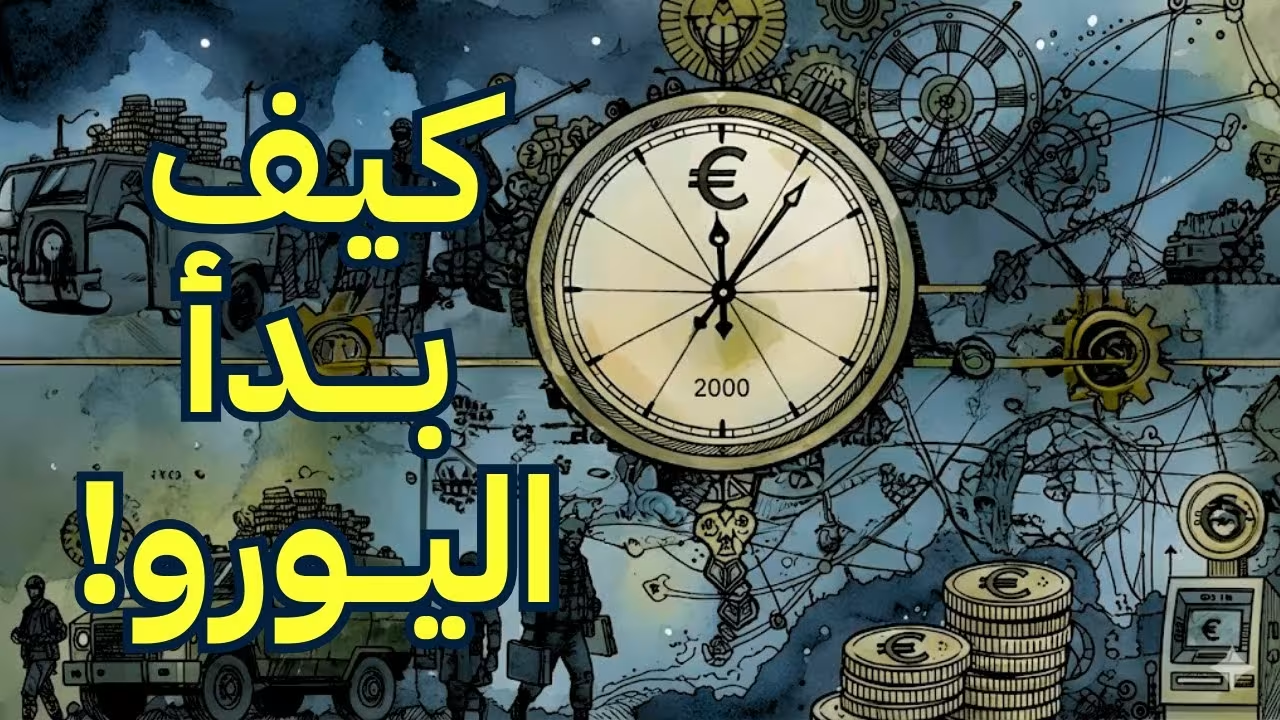
In the grand tapestry of modern history, few endeavors stand out as boldly as the creation of the Euro. It wasn't merely a technical decision to swap national currencies; it was a profound political act, a leap of faith designed to bind nations together, to foster peace and prosperity on a continent scarred by centuries of conflict. Conceived in the aftermath of two World Wars, the Euro aimed to transform a fragmented marketplace into a cohesive economic powerhouse, making war not just unthinkable, but economically improbable.
This ambitious project, now a quarter-century old, has traversed a landscape filled with both triumphs and tribulations. From its complex birth in the late 20th century to navigating global financial crises and geopolitical upheavals, the Euro has become far more than just a medium of exchange. It is a symbol of European identity, a testament to collective will, and a constant experiment in balancing national sovereignty with supranational integration.
Join us as we journey through the Euro's fascinating past, its present challenges, and its future aspirations – from the analog origins to the digital horizons, exploring how this single currency has reshaped Europe and continues to adapt to a rapidly changing world.
From Dreams to Reality: The Euro's Rocky Genesis
A Response to Chaos
The seeds of the Euro were sown long before its physical launch. Post-World War II Europe desperately sought stability. The Bretton Woods system, linking global currencies to the US dollar and gold, provided some calm, but its collapse in the late 1960s plunged the continent into monetary uncertainty. European leaders quickly recognized that the burgeoning common market, established by the Treaty of Rome in 1957, couldn't thrive amid fluctuating exchange rates. This realization spurred early efforts, notably the 1970 Werner Report, which laid out a vision for economic and monetary union by 1980 [1].
The "Snake" and the Blueprint
These early ambitions weren't without their bumps. Attempts like the "Snake in the Tunnel" in 1972 tried to limit currency fluctuations but ultimately succumbed to speculative pressures [2]. The real breakthrough came with the European Monetary System (EMS) in 1979, which linked participating currencies within narrow bands, providing a decade of exchange rate stability and laying the groundwork for greater coordination [2]. The momentum peaked with the Delors Report in 1989, a detailed blueprint for a three-stage path to Economic and Monetary Union (EMU), emphasizing capital liberalization, institutional development, and eventually, the irreversible fixing of exchange rates and the transfer of monetary policy to a new central banking system [3].
The Cornerstone: Maastricht and the Strict Rules of Entry
More Than Just a Treaty
The Maastricht Treaty, signed in February 1992, wasn't just another agreement; it was the constitutional bedrock for the modern European Union and its single currency. It transformed the European Economic Community into the European Union and, crucially, established the stringent criteria for joining the monetary club [3].
The Convergence Criteria
To ensure the stability and credibility of the future currency, Maastricht introduced four key economic convergence criteria [4]:
- Price Stability: Inflation rates no more than 1.5 percentage points above the average of the three best-performing EU countries.
- Sound Public Finances: A government budget deficit no higher than 3% of GDP and public debt no higher than 60% of GDP (or rapidly approaching it).
- Exchange Rate Stability: Participation in the European Monetary System (ERM II) without severe tensions for at least two years, avoiding devaluation.
- Long-Term Interest Rates: No more than 2 percentage points above the average of the three best-performing EU countries in terms of price stability.
"These criteria were designed to foster a high degree of sustainable economic convergence among Member States, preventing countries with unstable economies from undermining the stability of the Eurozone." [4] This commitment to fiscal discipline was further solidified by the Stability and Growth Pact (SGP), designed to ensure continued adherence even after Euro adoption, though its early enforcement faced political challenges [5].
The Grand Unveiling: From Virtual Currency to Tangible Cash
The Birth of a Name
After much debate, the name "Euro" was agreed upon by the European Council in Madrid in December 1995, beating out alternatives like "Ecu." It was decided that "Euro" would be written in both Latin and Greek alphabets on banknotes, a nod to Europe's diverse linguistic heritage [2].
Virtual Launch and Early Adopters
At the stroke of midnight on January 1, 1999, the Euro officially came into existence as a virtual currency. Exchange rates between the 11 founding national currencies and the Euro were irrevocably fixed [6]. From that moment, national currencies ceased to exist independently, becoming mere subdivisions of the Euro for accounting and electronic transactions. The newly established European Central Bank (ECB) took full responsibility for monetary policy across the Euro area [2]. Greece, unable to meet the convergence criteria in the first wave, joined two years later in January 2001 [6].
The Day the Cash Arrived
The most visible transformation for citizens arrived on January 1, 2002, when Euro banknotes and coins were introduced into circulation across 12 countries. This massive logistical undertaking involved "front-loading" commercial banks with Euro cash from September 2001, allowing them to supply retailers with smaller denominations by December 2001 to ensure smooth change-giving from day one. A brief period of dual circulation, where old national currencies and the Euro were both legal tender, facilitated a gradual transition before national currencies were fully withdrawn by the end of February 2002 [2].
Growing Pains and Existential Threats: The Sovereign Debt Crisis
The "Honeymoon" and Its End
The Euro's first decade was often described as a "honeymoon" period. Interest rates in southern European countries converged with Germany's, leading to cheap credit and a surge in investment. However, this apparent stability masked deep structural imbalances that exploded with the global financial crisis of 2008 [7].
Cracks in the Foundation
The crisis revealed a critical design flaw: a monetary union without a robust fiscal or banking union. Countries like Greece, Ireland, Portugal, and Spain, hit by the crisis, couldn't devalue their own currencies to regain competitiveness. Their only option was "internal devaluation" through wage cuts and public spending reductions, leading to deep recessions and social unrest [7]. Economist Paul De Grauwe highlighted the "doom loop," where declining government bond prices weakened banks holding those bonds, forcing governments to bail out banks, further increasing national debt and creating a vicious cycle that threatened to unravel the entire system [8].
The Drastic Response
The EU and IMF responded with massive bailout packages tied to strict austerity measures. But the real turning point came in the summer of 2012 when ECB President Mario Draghi famously declared he would do "whatever it takes" to preserve the Euro. This commitment, backed by the Outright Monetary Transactions (OMT) program, which allowed the ECB to buy distressed government bonds, calmed markets and broke the speculative cycle [8].
The Euro Today: Resilience Amidst Geopolitical Storms
A Boost for Trade
One of the Euro's core promises was to boost trade among member states by eliminating exchange rate risks. Data confirms this impact: studies based on the "gravity model" show that the Euro has generally increased intra-EU trade by 5% to 15%, with even larger effects (up to 30%) in intermediate goods supply chains among founding and newer member states [9]. Eurostat data for 2024 reveals that intra-EU trade remains the backbone of the economy, with exports between EU countries reaching €4,135 billion, 1.6 times the value of exports outside the EU [10].
War, Inflation, and the Cash Paradox
While the Euro maintained price stability for a long period, the war in Ukraine in 2022 delivered a significant inflationary shock. Europe's reliance on Russian energy led to soaring food and energy prices, pushing inflation to record highs of 8.4% in 2022 [11]. The war exposed the Euro's vulnerability to geopolitical shocks, even seeing the Euro briefly reach parity with the US dollar in July 2022 for the first time in 20 years [12]. Interestingly, the conflict also triggered a "cash paradox" in countries bordering Ukraine and Russia (like the Baltics and Slovakia), where demand for physical Euro banknotes surged as an emergency store of value, underscoring the Euro's role as a regional safe haven in times of crisis [13]. Projections for late 2025 and 2026 indicate inflation is expected to gradually return to the ECB's 2% target [14].
The Road Ahead: Unfinished Business and Digital Frontiers
The Unconverted: Why Some Still Resist
Despite the Euro's widespread adoption, some EU countries, like Sweden, Poland, Hungary, and the Czech Republic, deliberately avoid joining. While all EU members (except Denmark) are legally obliged to eventually adopt the Euro, these nations exploit a loophole: Euro adoption requires participation in ERM II for two years. By simply not joining ERM II, they "technically" fail to meet the conditions, indefinitely postponing Euro adoption [15]. Reasons often include a desire to retain monetary sovereignty, giving their central banks flexibility with interest rates and exchange rates during crises [16], and public skepticism, with opinion polls showing declining support for Euro adoption due to fears of price increases and loss of economic independence [17].
Strengthening the Core: Capital Markets Union
To further bolster the Euro's strength and competitiveness, Europe is pursuing strategic projects. The Capital Markets Union (CMU) aims to integrate national capital markets into a deep, unified European market, facilitating funding for startups and innovation [18]. Currently, Europe's financial system remains heavily bank-dependent, unlike the US which relies more on capital markets. Progress on CMU has been slow due to member states' reluctance to cede sovereign control over regulation and insolvency laws, resulting in European market capitalization being significantly smaller than its American counterpart [19].
The Future is Digital: The Digital Euro Project
In response to the decline of cash usage and the rise of cryptocurrencies, the European Central Bank has launched the Digital Euro project. Its goal is to provide a public, free-to-use digital payment method that ensures privacy (though not full anonymity to prevent illicit activities) and reduces reliance on foreign payment providers like Visa and Mastercard [20]. The preparatory phase concluded in late 2023, with legislation expected by 2026 and a potential launch in 2029 [20]. Challenges remain, including concerns from commercial banks about deposit outflows and ongoing debates about privacy, requiring a delicate balance in its design [21].
The Euro on the World Stage: A Dollar Challenger?
A Strong Second, But Not a Crown Contender
After a quarter-century, the Euro has firmly established itself as the world's second most important currency, but it hasn't unseated the US dollar from its throne. According to IMF data from Q3 2024, the Euro consistently holds around 20% of global allocated foreign exchange reserves, a stable figure that reflects confidence in its value as a reserve currency and safe haven [22].
The Missing Piece
However, its global reach is somewhat limited by the absence of a unified safe asset, comparable to US Treasury bonds, across the entire Euro area. This structural gap hinders its full potential to challenge the dollar's dominance, highlighting the ongoing need for deeper fiscal integration [22].
Watch the Full Discussion
Sources & References
Key Sources
- Euro – history and purpose | European Union
- History of the euro - Historical review | Bank of Greece
- History of the European Union – 1990-99
- Convergence criteria for joining - Economy and Finance
- Euro area crisis - Wikipedia
- History of the euro - Wikipedia
- Euro area crisis - Wikipedia
- Breaking the vicious circle of the Eurozone debt crisis – LSE
- Trade Volume Effects of the Euro: Aggregate and Sector Estimates - ResearchGate
- Intra-EU trade in goods - main features - Statistics Explained - Eurostat
- One year since Russia's invasion of Ukraine – the effects on euro area inflation - European Central Bank
- The dollar and euro exchange rates break even - FRED Blog
- The impact of war: extreme demand for euro cash in the wake of Russia's invasion of Ukraine - European Central Bank
- Autumn 2025 Economic Forecast shows continued growth despite challenging environment
- Why 7 EU Countries Don't Adopt the Euro Currency - Investopedia
- Why 7 EU Countries Don't Adopt the Euro Currency - Investopedia
- Support for euro adoption wanes in Poland, study shows - TVP World
- Full article: Playing the capital market? Sustainable finance and the discursive construction of the Capital Markets Union as a common good - Taylor & Francis Online
- Capital Markets Union Key Performance Indicators – Eighth Edition: Turning strategy into action during a period of change - AFME
- Eurosystem moving to next phase of digital euro project - European Central Bank
- Europe to get digital euro in 2029 – independent of Visa and Mastercard
- Currency Composition of Official Foreign Exchange Reserves - IMF Data Brief
View Full Bibliography
- Which EU Countries Don't Use the Euro? - Bound
- The Euro as a Privilege? Some Member States Do Not See It That Way! – Wonderinterest
- Digital euro progresses to next phase. Launch expected in 2029 - Ledger Insights
- Currency Composition of Official Foreign Exchange Reserves - IMF Data Brief
- Convergence criteria for joining - Economy and Finance
- Convergence criteria - (European History – 1945 to Present) - Vocab, Definition, Explanations | Fiveable
- Euro convergence criteria – Wikipedia
- The Euro crisis – What role did the common currency play? - World Bank Blogs
- The impact of the euro on trade: two decades into monetary union - European Central Bank
- International trade in goods - an overview - Statistics Explained - Eurostat
- Enlargement of the eurozone - Wikipedia
- Eurozone - Wikipedia
The Euro's journey is a powerful narrative of European ambition. It began as a political dream, a mechanism to weave the destinies of European nations so closely that conflict would become obsolete. Through a complex and precise launch, it transformed into the everyday economic reality for over 350 million people. The project has succeeded in forging a genuine single market, curbing inflation for decades, and enduring existential crises that threatened to tear it apart.
Yet, the Euro's architecture remains unfinished. Without a full fiscal and banking union, and a deep, integrated capital market, it remains susceptible to asymmetric shocks. The next challenge for the Euro is not merely to convince reluctant nations to join or to successfully launch its digital version by 2029. It is to strengthen Europe's "strategic autonomy" in a world increasingly moving towards geopolitical blocs and the politicization of the financial system. The Euro's impact today extends far beyond economics; it is the frontline defense of the entire European project.