Chess isn't just a game; it's a profound narrative woven into the fabric of human history. Across 64 squares, it mirrors the art of war, the depth of strategy, the beauty of art, and the raw power of intellect. For over 1500 years, this venerable game has showcased an unparalleled ability to evolve and adapt, transcending empires, linguistic barriers, and cultural divides. It is, unequivocally, the "game of immortality." This is a saga of an idea that journeyed across time and space, transforming with each civilization that embraced it, yet retaining its core essence as a cerebral duel between two minds.
How did an ancient war game, born in the palaces of India, manage to cross the Silk Road and vast deserts, be adopted by the Persian Empire, then refined by scholars and poets during Islam's Golden Age? How did it undergo a radical revolution in its rules during the European Renaissance, ultimately becoming a globally unified mental sport governed by international bodies and played by hundreds of millions online?
To answer this, we embark on a detailed historical odyssey, tracing the path of chess pieces across continents and centuries. Our journey begins with its enigmatic origins in India as "Chaturanga," follows its maturation and development in Persia and the Islamic world, witnesses its dramatic transformation in Europe into its modern form, and examines the era of standardization and professionalization in the 19th century that saw the birth of the first official world championship. Finally, we arrive at the digital age, where the confrontation between man and machine and the rise of online platforms have sparked a new revolution in the history of this ancient game.
The Cradle of Strategy: Ancient India and Chaturanga
Tracing the origin of chess is akin to excavating deep historical layers, where facts mingle with legends and competing narratives vie to tell the story of its birth. However, there's a broad consensus among historians: the game's birthplace was the Indian subcontinent, within the crucible of a rich civilization that produced one of the most enduring intellectual games in human history.
Chaturanga: The Sacred Indian Ancestor
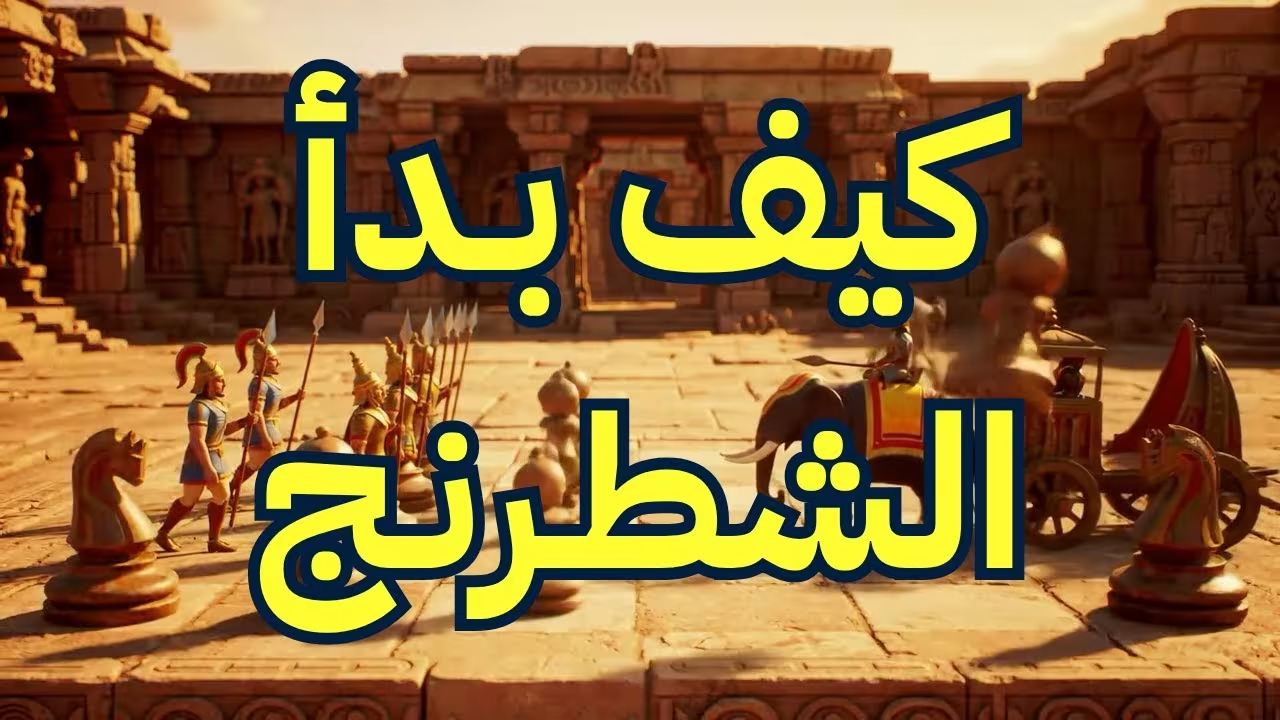
Most historians agree that the origins of chess can be traced to India during the Gupta Empire, a period estimated to be the 6th century CE [2]. The game was then known as "Chaturanga" (Sanskrit: caturanga), a term meaning "four divisions" or "four limbs" [6]. This name was no mere coincidence; it accurately represented the fourfold composition of the ancient Indian army: infantry, cavalry, elephants, and chariots. This intimate link to the military confirms that the game was conceived from its very beginning as a strategic simulation of war, not merely a pastime [1].
The pieces of Chaturanga and their rudimentary movements formed the nucleus from which all subsequent forms of chess evolved. Their movements were as follows:
- Raja (King): Moves one square in any direction, identical to the modern king's movement.
- Mantri (Minister or General): This piece was significantly weaker than its modern counterpart, moving only one square diagonally. This weakness was a key difference between ancient and modern chess, slowing down the pace of play and making it more strategic.
- Ratha (Chariot): Moves straight, horizontally and vertically, any number of squares, just like the modern rook.
- Gaja (Elephant): The movement of this piece was the most varied and unstable in the ancient rules. Literary sources suggest three possible movements: jumping two squares diagonally, moving one square forward or one square diagonally (similar to the "Silver General" in Japanese Shogi), or jumping two squares orthogonally (horizontally or vertically).
This diversity in the elephant's movement suggests that the game's rules weren't fully standardized even in its early stages, and perhaps varied from region to region. In some of its earliest forms, Chaturanga was played between four players, and sometimes dice were used to determine which piece to move, adding an element of chance to strategic skill [4]. The game was also played on an uncolored board (not checkered black and white) [4].
The Debate: Was China an Alternative Cradle?
Despite the strong evidence pointing to an Indian origin, an alternative theory suggests China as a possible birthplace for chess. Proponents of this theory believe that chess developed from a Chinese game called "Xiangqi" or an older ancestor known as "Liubo," and that its presence in China might predate Chaturanga's appearance in India, possibly as early as the 2nd or 3rd century BCE [4].
This argument is based on certain evidence, such as ancient Chinese poems believed to refer to the game before the 6th century CE. Some historians also argue that the absence of early Sanskrit literary mentions of chess in India is a weakness in the Indian origin theory. However, critics of the Chinese theory point out that the supporting evidence lacks strong and direct historical documents [4]. The debate continues, though most historians lean towards the Indian perspective.
This ambiguity isn't a failure of historical research but rather a testament to the nature of idea dissemination in the ancient world. There was no "patent" or unified "user manual." Chess evolved not as a singular event but as a continuous process of cultural exchange via trade routes like the Silk Road [2]. Chess-like games likely developed in parallel in different regions and influenced each other, making the identification of a single "point of origin" difficult and misleading. The debate itself is a historical artifact of this complex process.
Chess in Epics and Legends
The birth of chess is shrouded in rich, symbolic legends, each narrating an aspect of the game's philosophy.
- The Shahnameh Legend: The great Persian epic, the "Shahnameh" by Ferdowsi, tells a poignant story about the invention of chess. After the Indian King Talhand was killed in battle against his brother Go, their grieving mother refused to believe he died without direct combat. To convince her, Indian sages gathered ivory and teak pieces, fashioned a board, and simulated the battle, explaining how the king could be surrounded and defeated (checkmate) without being physically harmed [10].
- The Wheat Grains Legend: The most famous legend tells of an Indian sage, sometimes called Sissa or Sessa, who presented the game to his prince, Shahram, to relieve his boredom. The prince was greatly impressed and offered the sage any reward he wished. The sage made a seemingly modest request: one grain of wheat on the first square of the chessboard, two on the second, four on the third, and so on, doubling the number for each subsequent square. The prince scoffed at the request but soon realized that fulfilling it was impossible, as the total number of wheat grains (18,446,744,073,709,551,615) would exceed the world's harvest for thousands of years.
These narratives, whether historical or legendary, reveal a deep truth about the game's perceived purpose in its early stages. It wasn't merely a pastime but a pedagogical tool designed to instill lessons in strategy, the importance of every individual in the kingdom from king to soldier, and the power of mathematical concepts. The identity of chess as the "game of kings" [9] wasn't just a title acquired later; it was an integral part of its DNA from birth. It was designed as an intellectual simulation of governance and warfare, which explains its rapid adoption by elites in every civilization it encountered.
The Silk Road's Intellectual Cargo: Chess in Persia and the Islamic Golden Age
Chaturanga did not remain confined to India for long. Like great ideas and precious spices, it embarked on a long journey across trade routes and caravans, reaching the neighboring Persian Empire, and from there, the heart of the burgeoning Islamic world, which would become the most important incubator and developer of the game for several centuries.
From Chaturanga to "Shatranj": The Persian Stop
Historical evidence, including a Persian manuscript dating back to 600 CE, indicates that the game migrated from India to Sasanian Persia in the 6th century. This transition is believed to have occurred through diplomatic and trade channels. Stories recount that ambassadors from the King of India presented the game as a gift to the Persian King Khosrow I Anushirvan (reigned 531-579 CE) [11].
In Persia, the game underwent its first transformations. Its name was linguistically adapted from Sanskrit "Chaturanga" to Persian "Chatrang." More importantly, it became deeply entrenched as an essential part of princely and royal education for nobles, solidifying its status as a game for the elite [8].
The Islamic Golden Age: The Incubator and Developer
With the Islamic conquest of Persia in the mid-7th century (around 638-651 CE), Arabs encountered "Chatrang" and embraced it with unprecedented passion. The name underwent further Arabization, becoming "Shatranj," as the Arabic language lacks the "ch" and "ng" sounds [8].
The Islamic world was not merely a carrier of the game; it was a laboratory, catalyst, and developer for it. Under the Abbasid Caliphate, especially in Baghdad, chess reached its golden age. The game enjoyed immense popularity in the courts of caliphs like Al-Mahdi, Harun al-Rashid, and Al-Ma'mun. Harun al-Rashid was once asked, "What is chess?" to which he replied, "It is life." The jurist Muhammad ibn Sirin described it as "the essence of men." [15].
In this flourishing intellectual environment, chess witnessed crucial developments:
- Birth of Chess Theory: For the first time in history, chess was no longer merely a game to be played but became a subject of study. Great players emerged who were also the first theorists of the game, such as Al-Adli (around 840 CE), Ar-Razi, and Abu Bakr al-Suli. These masters not only played but also authored the first chess books, analyzed openings, and created complex tactical problems known as "mansubat" [14].
- Player Classification: Arabs were the first to establish a system for classifying players based on their strength. Exceptional players were known as "Al-Aliyat" and were employed in the caliphs' courts for competition and instruction. This concept predated modern international rating systems by nearly a thousand years.
- Abstract Pieces: Religious views had a profound impact on the shape of the pieces. While some jurists, like Imam Al-Shafi'i, permitted chess under certain conditions (not playing for stakes, not distracting from prayer), others disliked or prohibited it. The Islamic prohibition against depicting living beings led to a radical change in the appearance of the pieces. Figural representations of animals (elephants) and humans (kings, soldiers) were abandoned and replaced with abstract, symbolic shapes carved from clay or stone [4]. This abstraction not only made the game religiously acceptable but also contributed to its universal appeal, making it less tied to its original Indian culture.
The Islamic role was crucial in transforming chess from an ancient war game with varied rules into an organized and abstract intellectual system. They "codified" the game intellectually and aesthetically, paving the way for its global spread and subsequent developments in Europe. Without this stage, chess might have remained merely a regional folk game.
The European Renaissance: A Queen's Gambit and the Birth of Modern Chess
From the Islamic world, chess began its journey westward, reaching Europe through two main gateways around the 10th century CE [18]:
- Al-Andalus (Spain): Andalusia served as the primary bridge for chess to enter Europe. It is said that the renowned musician and intellectual Ziryab brought the game with him from Baghdad to Cordoba in the 9th century [15]. In the multicultural society of Al-Andalus, the game spread among Muslims, Christians, and Jews. King Alfonso X's "Book of Games" (1283 CE) indicates that chess served as a means of coexistence among them [18]. From Al-Andalus, Mozarab monks (Christians living under Islamic rule) carried the game northward to Christian kingdoms, and from there to France and the rest of Europe [18].
- Sicily and Southern Italy: Trade and political relations between the Islamic world and Italy formed another gateway for chess to enter the continent [17].
The journey of chess is a remarkable example of "soft power" in history. It didn't spread by the sword but through diplomatic gifts (as in the story of Khosrow, or the alleged gift from Harun al-Rashid to Charlemagne) [11], and through cultural figures like Ziryab, monks, and merchants. It acted as a cultural bridge between India and Persia, and between the Islamic world and Christian Europe, at times when conflicts were prevalent.
"Alla Rabiosa" - The Angry Queen's Revolution
When chess arrived in Europe during the Middle Ages, it was still in its Eastern form, known as "Shatranj" – a slow, strategic game focused on long-term maneuvers. However, in the fertile ground of Renaissance Europe, a radical and silent transformation occurred, a revolution in rules that altered the game's face forever, unleashing a dynamism and tactical power previously unknown.
The most significant change in chess history occurred in Southern Europe, most likely in Spain or Italy, around 1475 CE [18]. This change, sometimes called "scacchi alla rabiosa" (angry chess) by Italians, involved two main pieces:
- The Queen's New Power: The "Fers" piece (derived from the Persian minister), which previously moved only one square diagonally, suddenly transformed into the most powerful piece on the board. The new "Queen" was granted the ability to move any number of squares horizontally, vertically, and diagonally, combining the power of the rook and the bishop [17]. This monumental change dramatically sped up the pace of play and made direct attacks on the king more common and lethal.
- The Bishop's Evolution: The ancient elephant piece, known in Spain as "Alfil" (from Arabic), used to jump two squares diagonally. In the new rules, the bishop gained its modern movement, capable of moving any number of squares diagonally, but always remaining on squares of the same color [17].
Some historians link this dramatic increase in the Queen's power to the simultaneous rise of powerful and influential queens in Europe, most notably Isabella I of Castile in Spain [18]. Whether this connection is direct or not, it illustrates how social and cultural transformations can be reflected even in the rules of an abstract game. This revolution in rules was a shift in the game's "philosophy"; from simulating prolonged warfare and siege to simulating decisive and rapid battles, reflecting the dynamism and expansion characteristic of the European Renaissance.
Completing the Modern Rules
Alongside the radical changes in the Queen's and Bishop's movements, other rules were introduced during the 15th and 16th centuries, completing the modern form of chess:
- Castling: This complex rule was added around 1550 CE [17]. It is the only move that allows two pieces (King and Rook) to move in one turn, serving a dual purpose: protecting the king by moving it away from the center of the board and activating the rook by bringing it into play quickly.
- Pawn Promotion: The rule for a pawn reaching the last rank evolved. While promotion was previously restricted (sometimes only to the weak Fers piece), it became possible to promote a pawn to any piece the player chooses (usually the powerful Queen) [21], adding immense strategic depth, especially in endgames.
- En Passant: This rule, added around 1450 CE, was a direct response to allowing pawns to move two squares on their first move. The En Passant rule allows an opponent's pawn to capture a pawn that moved two squares as if it had only moved one, but only on the immediately subsequent turn [17].
From Play to Study: The Dawn of European Theory
With the stabilization of the new rules, a new era of game study began. The first printed books on chess appeared in Europe, such as the Spanish priest Luis Ramirez de Lucena's "Repetición de Amores y Arte de Axedrez" (c. 1497 CE), which was among the first works to document the new Queen's and Bishop's movements [21].
In the subsequent centuries, strategic thought developed significantly. In the 18th century, the French musician and chess player François-André Danican Philidor emerged as the father of modern strategy. In his book "L'Analyze du jeu des Échecs" (1749), Philidor emphasized the importance of pawn structure, famously declaring, "Pawns are the soul of chess." He shifted the focus from direct tactical attacks to long-term strategic planning, a concept that influenced generations of players.
The cultural adoption mechanism of chess in Europe reveals a crucial process: for a foreign idea to succeed in a new society, it must be "translated" into its specific concepts and symbols. The linguistic and cultural transformation of piece names was essential. The "Vizier" piece became the "Queen," and the "Alfil" (from Arabic) became the "Bishop" [19], perhaps because the abstract shape of the piece resembled a bishop's mitre. This "cultural translation," even if it started with a "mistake," was necessary to root chess in European soil and pave the way for its subsequent revolution.
From Cafes to World Stage: The Age of Organization and Professionalism
After the modern rules of chess were established in Europe, the game entered a new stage of maturity in the 19th century. It transformed from an aristocratic pastime played in salons and cafes into an organized mental sport with its champions, tournaments, and institutions. This period marked the "coming of age" for chess, where its modern identity was fully formed.
The Romantic Era of Chess
The first half of the 19th century was characterized by a playing style known as the "Romantic Era." This style focused on daring attacks, spectacular sacrifices, and striving for checkmate at all costs, often disregarding defensive and long-term strategic principles [17]. Players sought artistic beauty in play more than victory by any means. Informal champions who captivated the world emerged during this period, such as the German Adolf Anderssen and the American Paul Morphy, widely considered the strongest players of their time.
Towards Unification and Professionalism
The 19th century witnessed rapid development in chess infrastructure. Many chess clubs emerged in major European cities, and specialized books and journals began to spread, contributing to the dissemination of chess knowledge [4]. Correspondence games between cities, such as the famous match between London and Edinburgh in 1824, became a popular way to compete and exchange ideas [16].
More importantly, this century saw concerted efforts to definitively unify the game's rules, which still had slight variations between countries. By mid-century, the laws had reached their current stable form. This unification paved the way for organizing standardized international tournaments. The first major international tournament was held in London in 1851, coinciding with the Great Exhibition, while the first American tournament was held in New York in 1843 [13].
Crowning the First Official World Champion
The culmination of this era of organization was the first official World Chess Championship match in 1886. This historic event was more than just a game; it was an announcement that chess had become a professional sport with its pinnacle.
- The Contestants: The match brought together Wilhelm Steinitz, a player from the Austro-Hungarian Empire and later the United States, and Johannes Zukertort, a Polish-born player representing Great Britain [26].
- Venue and Result: The match was held in three American cities: New York, St. Louis, and New Orleans. After a fierce competition, Steinitz secured victory with a decisive score of 10 wins to 5 for Zukertort, with 5 draws, thereby becoming the first official and recognized World Chess Champion in history [26].
Steinitz's victory was not merely a personal triumph; it was a philosophical turning point in the game's history. It was a victory for his "positional" and "scientific" style over the aggressive "Romantic" style represented by Zukertort. Steinitz proved that victory comes not only from brilliant attacks but can be built systematically through a deep understanding of strategic principles, such as central control, the importance of pawn structure, and accumulating small advantages. This shift laid the foundations for all subsequent modern chess theory, marking the beginning of the "Scientific Era" of chess.
Institutional Foundation: The Birth of FIDE
With the increasing number of international tournaments and the need for a unified world championship, the necessity for a supreme international body to oversee the game emerged. On July 20, 1924, on the sidelines of the unofficial Chess Olympiad in Paris, the Fédération Internationale des Échecs (FIDE) was founded [16].
FIDE adopted the Latin motto "Gens una sumus," meaning "We are one family," expressing its ambition to unite chess players worldwide [28]. FIDE took on the responsibility of definitively and officially unifying the rules, organizing the official Chess Olympiads (starting in 1927), overseeing world championship matches, and granting official international titles such as "International Master" and "Grandmaster" [28]. With the establishment of FIDE, the institutional structure of chess as a global sport was complete.
The Silicon Showdown: Deep Blue, AI, and the Digital Revolution
With the dawn of the digital age, chess entered a new phase of evolution, arguably the most revolutionary since the rule changes in the Renaissance. The confrontation between human intellect and artificial intelligence, coupled with the spread of online playing platforms, has radically transformed how the game is played, studied, and shared globally.
The "Deep Blue" Moment: The End of Absolute Human Supremacy
May 11, 1997, marked a watershed moment in the history of chess and artificial intelligence. On that day, in the famous rematch held in New York, IBM's supercomputer "Deep Blue" defeated the reigning world champion, the legendary Garry Kasparov [31].
- The Historic Match: The match consisted of six games. After five games, the score was tied 2.5-2.5. In the decisive sixth game, Kasparov collapsed under pressure and lost quickly.
- The Shocking Result: Deep Blue won the match with a total score of 3.5-2.5, becoming the first computer in history to defeat a reigning world champion in a classical time control match [31].
- Significance and Impact: This defeat was a cultural and scientific shock. It ended a long era where human intellectual superiority in chess was absolute and undisputed. The match sparked widespread debate about the future of human intelligence in the face of computational power. Kasparov, disbelieving what had happened, accused the IBM team of cheating, claiming some of the computer's moves were "too human" and must have been the result of human intervention [32]. Regardless of the veracity of these claims, the "Deep Blue" moment was a declaration that machines were no longer just tools but had become genuine competitors in one of the most creative domains of the human intellect [34].
The Chess Engine Revolution in the Silicon Age
Deep Blue was just the beginning. In the years that followed, chess engines evolved dramatically. They transitioned from being giant, expensive supercomputers confined to corporate labs to powerful software programs accessible to everyone, runnable on personal computers and even smartphones. Programs like "Stockfish" and "AlphaZero" (developed by DeepMind) became significantly stronger than any human player [34].
This revolution in engine power fundamentally changed the game:
- Changing Training Methods: Using engines to analyze games has become an integral part of serious chess training for everyone, from amateurs to world champions. These tools allow players to review their games meticulously, identify mistakes, and understand the best possible moves in any position.
- Revolution in Opening Theory: Engines have analyzed openings in unprecedented depth, uncovering new ideas and lines of play previously unknown, and re-evaluating many old openings.
- AI as a Training Partner: Tools have evolved into "smart coaches," using AI to analyze a specific player's style, identify recurring weaknesses, and design personalized training and puzzles to aid improvement [36].
The story of chess and artificial intelligence is not one of conflict, but of adaptation and shared evolution. AI hasn't "killed" chess; instead, it has pushed it to new levels of complexity and creativity. It has freed human players from the burden of precise tactical calculations, allowing them to focus more on deep strategic and creative concepts.
Chess for Everyone: The Phenomenon of Online Play
Parallel to the engine revolution was the internet revolution. Online chess platforms, most notably Chess.com and Lichess, have "democratized" the game, making it accessible to everyone as never before.
- Massive Popularity: Platforms like Chess.com boast over 70 million members and host over nine million games daily [3]. You can find an opponent from anywhere in the world, at your skill level, at any time of day or night.
- COVID-19 Boom: Online chess popularity surged unprecedentedly during the COVID-19 pandemic, as millions turned to the game for entertainment and intellectual connection during lockdowns.
- Streaming Culture: Streaming platforms like Twitch and YouTube have transformed chess into an engaging spectator sport. Top players and influencers stream their games live, interact with audiences, and provide educational and entertaining content, attracting a new generation of young people to the game.
The digital age has transformed the nature of skills required in chess. In the past, mastery relied heavily on memorizing vast amounts of theory. Now, with all this information readily available to everyone, the importance of memorization has diminished. Practical skills like time management, psychological resilience, and making practical decisions in complex positions have become more critical than ever. The internet and AI have redefined what it means to be a strong chess player, shifting the focus from memory to performance.
Watch the Full Discussion
Sources & References
Key Sources
- تاريخ الشطرنج ورمزيته.. كيف تحولت إلى لعبة الملوك؟ - التلفزيون العربي
- شطورانجا - ويكيبيديا
- حكاية اختراع الشطرنج في ملحمة "الشاهنامة" | الجادّة - جاده ايران
- شطرنج - ويكيبيديا
- الشطرنج عبر العصور - موقع الجسرة الثقافي
- الشطرنج دخل إلى أوروبا من البوابة الأندلسية - الشرق الأوسط
- وزير (شطرنج) - ويكيبيديا
- بطولة العالم للشطرنج 1886 - ويكيبيديا
- الاتحاد الدولي للشطرنج - ويكيبيديا
- Deep Blue versus Garry Kasparov - Wikipedia
- حتى لا يخسر في الشطرنج.. الذكاء الاصطناعي يحتال ويغش - مجلة عالم التكنولوجيا
- ما هو أفضل موقع للشطرنج؟ - Chess.com
View Full Bibliography
- من قصور الملوك والخلفاء إلى الحرب والعلاقات الدولية: القصة الملحمية للشطرنج - ميغازين, accessed September 22, 2025
- تاريخ الشطرنج ورمزيته.. كيف تحولت إلى لعبة الملوك؟ - التلفزيون العربي, accessed September 22, 2025
- ما هو أفضل موقع للشطرنج؟ - Chess.com, accessed September 22, 2025
- تاريخ الشطرنج - Wikiwand, accessed September 22, 2025
- لعبة الملوك المختلف حول نشأتها.. حقائق لا يعرفها كثيرون عن الشطرنج - الجزيرة نت, accessed September 22, 2025
- شطورانجا - ويكيبيديا, accessed September 22, 2025
- الهنود أم الصينيون أم الفرس أم العرب من منهم اخترع الشطرنج؟ - Landkreis Marburg-Biedenkopf, accessed September 22, 2025
- شطرنج - ويكيبيديا, accessed September 22, 2025
- .. لماذا يُطلق على الشطرنج لعبة الملوك؟.. أسرار لعبة حكمت الممالك - الوطن, accessed September 22, 2025
- حكاية اختراع الشطرنج في ملحمة "الشاهنامة" | الجادّة - جاده ايران, accessed September 22, 2025
- «الشطرنج» من الهند إلى بلاد العرب .. ومنها لأوروبا والعالم | الاقتصادية, accessed September 22, 2025
- من اخترع الشطرنج، وكيف نقله العرب إلى أوروبا؟ - عربي بوست, accessed September 22, 2025
- في اليوم العالمي للشطرنج.. معلومات تاريخية وحقائق مثيرة لا يعرفها كثيرون عن «لعبة الملوك», accessed September 22, 2025
- الشطرنج عبر العصور - موقع الجسرة الثقافي, accessed September 22, 2025
- حين استضاف البلاط العباسي أول بطولة عالمية في الشطرنج - مجلة المجلة, accessed September 22, 2025
- تاريخ الشطرنج - ويكيبيديا, accessed September 22, 2025
- تاريخ لعبة الشطرنج و دور العرب فيه حل لغز شطرنجي عمره ١٢٠٠ عام - YouTube, accessed September 22, 2025
- الشطرنج دخل إلى أوروبا من البوابة الأندلسية - الشرق الأوسط, accessed September 22, 2025
- أصل تسميات قطع الشطرنج عبر التاريخ - Chess.com, accessed September 22, 2025
- كتاب نادر يفسر قواعد الشطرنج القديمة - صحيفة الثورة, accessed September 22, 2025
- وزير (شطرنج) - ويكيبيديا, accessed September 22, 2025
- قوانين لعبة الشطرنج - موضوع, accessed September 22, 2025
- لعبة الشطرنج: قواعدها وكيفية لعبها – البلاد, accessed September 22, 2025
- قوانين الشطرنج - Wikiwand, accessed September 22, 2025
- احتفالاً باليوم العالمي للشطرنج 20 يوليو.. علمي طفلك لعبة الحكماء | مجلة سيدتي, accessed September 22, 2025
- بطولة العالم للشطرنج 1886 - ويكيبيديا, accessed September 22, 2025
- تاريخ بطولة العالم في الشطرنج - Yola, accessed September 22, 2025
- الاتحاد الدولي للشطرنج - ويكيبيديا, accessed September 22, 2025
- الاتحاد الدولي للشطرنج - المعرفة, accessed September 22, 2025
- Chess History: Creating FIDE - ChessBase, accessed September 22, 2025
- Deep Blue versus Garry Kasparov - Wikipedia, accessed September 22, 2025
- بطل العالم يخسر أمام حاسوب.. كيف أشعلت مباراة شطرنج واحدة ثورة البيانات الضخمة؟ - الجزيرة نت, accessed September 22, 2025
- Kasparov versus Deep Blue 1997 - Chessprogramming wiki, accessed September 22, 2025
- حتى لا يخسر في الشطرنج.. الذكاء الاصطناعي يحتال ويغش - مجلة عالم التكنولوجيا, accessed September 22, 2025
- تحليل لعبة الشطرنج عبر الذكاء الاصطناعي - Chariot Gemini API Developer Competition, accessed September 22, 2025
- إتقان تحليل الشطرنج والتدريب بالذكاء الاصطناعي - مدونة Chessigma, accessed September 22, 2025
- الشطرنج تنضم إلى كأس العالم للرياضات الإلكترونية 2025 بجوائز قياسية - جريدة الرياض, accessed September 22, 2025
- رسمياً: الشطرنج من ضمن منافسات كأس العالم للرياضات الإلكترونية 2025 - Esports World Cup, accessed September 22, 2025
Chess in the 21st Century: An Ever-Evolving Legacy
Chess has traversed a remarkable journey spanning fifteen centuries of human history. It began as "Chaturanga," a slow war game played in the palaces of India and Persia, symbolizing ancient armies. It then transformed in the Islamic world into "Shatranj," an art and science with its own theorists and literature. During the European Renaissance, it underwent a revolution that redefined it, making it a dynamic and fast-paced game. In the 19th century, it solidified its modern form as a competitive mental sport with its champions and institutions. Finally, in the digital age, technology embraced it, turning it into a global phenomenon played on smartphone screens and challenging the frontiers of artificial intelligence.
Looking to the future, chess's journey is far from over. With its increasing integration into the world of esports [37] and the evolution of AI not only revealing new insights into the game but also inspiring novel variations, chess continues to prove its capacity for renewal. The secret to chess's survival and immortality lies not in the rigidity of its rules, but in its incredible flexibility and its ability to reflect every era it passes through. It was a game for kings, philosophers, artists, and warriors, and today it is a game for the masses. In every stage of its development, chess has offered humanity more than just amusement; it has provided a universal language of logic, strategy, and creativity. This language, spoken across a board of two colors, will undoubtedly continue to captivate minds and inspire generations to come.