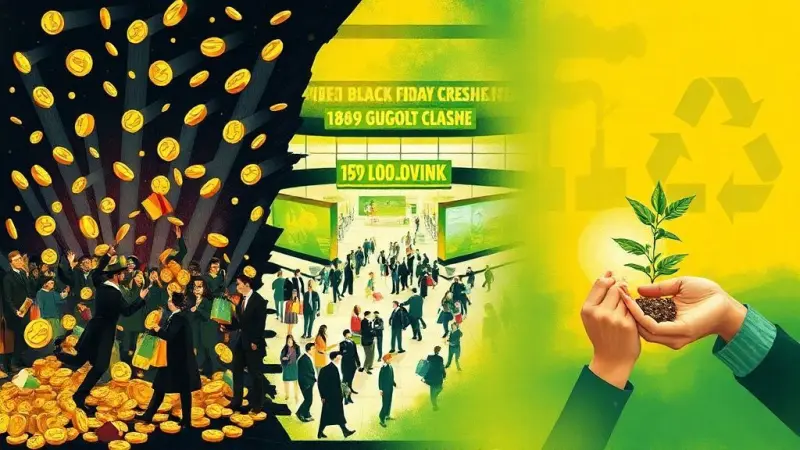
Imagine a day shrouded in chaos, greed, and financial ruin. A day when the very word “black” painted a picture of despair across a nation. Now, imagine that same day transformed, centuries later, into a global festival of consumption, a vibrant explosion of deals and discounts. This isn't just a marketing success story; it's a tale of reinvention, cultural clashes, and psychological manipulation.
Black Friday, the behemoth of modern retail, has a past far stranger and darker than most shoppers realize. Forget the catchy jingles and doorbuster deals for a moment, and step back in time. We're about to peel back the layers of history, debunk myths, and expose the hidden gears that make this annual shopping phenomenon tick – from Wall Street to your shopping cart, and beyond.
The Day Gold Crashed: Black Friday’s Original Sin
Our story begins not in a bustling mall, but on a panicked trading floor. The very first recorded “Black Friday” in American history had nothing to do with holiday shopping. It was a catastrophic financial event that rocked the nation to its core. The date? Friday, September 24, 1869 [1].
In that era, two notorious Wall Street speculators, Jay Gould and Jim Fisk, hatched a daring plot. Their goal: to corner the entire national gold market. They secretly bought up vast quantities of gold, hoping to artificially inflate prices to astronomical levels before selling off their holdings for immense profits [2]. Their scheme relied on corrupt connections to keep the U.S. government from intervening and releasing its own gold reserves.
The conspiracy reached its climax on that “Black” Friday. Gold prices surged wildly, threatening to cripple the American economy. Recognizing the grave danger, President Ulysses S. Grant issued an urgent order to the Treasury Department. The government abruptly flooded the market with its gold reserves, shattering Gould and Fisk’s monopoly [4]. The sudden influx caused gold prices to plummet, leading to immediate and severe losses for investors, from powerful financiers to ordinary farmers who saw their crop values cut in half [4].
In this context, “black” was a chilling descriptor for gloom, ruin, bankruptcy, and nationwide financial chaos. It held no positive association with profit or shopping. This dark meaning persisted for decades before the term was radically repurposed.
Debunking a Pervasive Myth: Black Friday and the Slave Trade
In the age of viral content, misinformation spreads like wildfire. A particularly disturbing myth emerged around 2018, claiming that Black Friday originated from a practice of selling enslaved people at discounted prices the day after Thanksgiving [7]. This claim is not only false but deeply offensive, and it’s important to understand why.
- Contradictory Timeline: Slavery was officially abolished in the United States with the Thirteenth Amendment in 1865 [1]. The term “Black Friday” in a retail context didn't appear until nearly a century later, in the 1950s and 60s [8]. Logically and historically, there can be no link between an institution that ended in the mid-19th century and a term that arose in the mid-20th century.
- Lack of Documentary Evidence: There are no newspaper clippings, commercial advertisements, or historical records from the era of slavery that use “Black Friday” to refer to the sale of human beings. All assertions promoting this theory lack any archival support [10].
- Misleading Imagery: Posts promoting this myth often feature old images of chained individuals. However, historical investigations have revealed that these images are not of enslaved people in America but rather of aboriginal prisoners photographed in Australia in 1905 [8].
The spread of this myth highlights the phenomenon of “digital folklore,” where emotionally charged or controversial origins are invented for popular terms to fill perceived knowledge gaps. Critical research and historical accuracy are crucial to correcting public understanding.
Philadelphia's Nightmare: The Police and the Birth of a Shopping Term
While the financial crash of 1869 faded from popular memory, the actual origin of “Black Friday” as a shopping term was forged in the streets of Philadelphia in the 1950s and 60s. But it wasn't a celebration of sales; it was a term of exasperation.
Philadelphia played host to a massive, traditional Army-Navy football game every Saturday after Thanksgiving. This event drew tens of thousands of tourists and fans to the city [1]. Their arrival coincided with local suburban shoppers flocking downtown to start their holiday gift-buying. For the Philadelphia police, bus drivers, and taxi drivers, that Friday was truly “black” in every sense of the word:
- Security Nightmare: Officers were forbidden from taking leave and assigned extra-long shifts to manage the overwhelming crowds [3].
- Traffic Chaos: Streets became gridlocked with cars and pedestrians, leading to massive traffic jams and a surge in accidents [2].
- Petty Crime: The intense crowds created perfect cover for shoplifters, adding to the burden of law enforcement [3].
A 1961 public relations bulletin officially documented police using “Black Friday” and “Black Saturday” to describe the headaches these days caused [10]. The term was so negative that city merchants desperately tried to rebrand it as “Big Friday” in the early 1960s, but their efforts failed. The “black” moniker stuck [2].
The Great Rebranding: From Chaos to Cash Flow
The term “Black Friday” remained largely confined to Philadelphia until the mid-1980s. As national retail chains grew, businesses realized they couldn't ignore a term that was starting to seep into national media. Instead of fighting it, marketers decided to reinvent it.
In a stroke of PR genius, a completely new interpretation of the term emerged in the 1980s, linking it to traditional accounting practices. In old ledgers, accountants used red ink to denote losses and black ink for profits [12]. Retailers spun a narrative: stores operated “in the red” (at a loss) from January through November, and the Friday after Thanksgiving marked the magical turning point when they finally moved “into the black” (became profitable) thanks to massive sales volumes [6]. This new explanation first appeared in the Philadelphia Inquirer in 1981 [6].
Though simplified and not entirely accurate for all businesses, this rebranding achieved two strategic goals:
- Erasing Negative Memory: The image of overwhelmed police and gridlocked streets was replaced with one of economic success and profitability.
- Legitimizing Consumption: Shopping on this day became a form of national participation, helping stores “stay in the black” and support the economy.
The Holiday Creep: From a Single Day to a 'Black Month'
Retailers didn’t stop at rebranding the day; they drastically reshaped its timeline to maximize returns:
- Doorbusters (1990s-early 2000s): This era saw stores opening at incredibly early hours (4 AM, then midnight). This created artificial scarcity and intense physical competition among shoppers for limited, heavily discounted items.
- Cyber Monday (2005): The National Retail Federation noticed employees returning to work after Thanksgiving weekend, using their fast office internet to shop online. The term “Cyber Monday” was coined to capitalize on this behavior, extending the shopping season into the following week [16].
- Holiday Creep (2020s and beyond): The single-day boundary has dissolved. We now see “Black November,” with deals starting at the beginning of the month, or even in October. This extension aims to ease logistical pressure on supply chains and spread consumer spending over a longer period, especially with the growth of e-commerce [16].
A Global Phenomenon: From Black to White to Yellow
When Black Friday crossed oceans to global markets, it faced a unique challenge, particularly in the Middle East and North Africa. How do you market a “black” day in a culture where Friday is revered as a holy day, a symbol of light and blessing?
The Cultural & Religious Conundrum
In Arab and Islamic collective consciousness, the color black often signifies mourning, sadness, and ill omen. Describing Friday, a day of immense religious significance, as “black” was not just a cultural shock but potentially an unintentional affront to local values [19]. Local entrepreneurs quickly realized that a direct translation of the American term would deter, rather than attract, consumers.
Souq.com and 'White Friday': A Masterclass in Localization
The pioneering adaptation of this event in the Arab world came from Souq.com, then the largest e-commerce platform in the region (later acquired by Amazon). In 2014, its founder, Ronaldo Mouchawar, observed the shopping frenzy in the U.S. and decided to bring the concept to the Middle East, but with a critical adjustment: localization [21].
Mouchawar strategically chose “White Friday” (جمعة بيضاء) as a local alternative [21]:
- Religious Symbolism: White is associated with purity, peace, and optimism in Islamic culture (e.g., pilgrim attire, shrouds) [20].
- Marketing Message: “Our Friday is White” became a slogan that beautifully blended reverence for the holy day with the joy of finding great deals [20].
- Digital Success: The campaign was a resounding success. In 2014, Souq.com sold over 600,000 products, increasing to 1 million by 2016 [23], proving that respect for cultural nuances is key to commercial success in the region.
Noon.com and 'Yellow Friday': The Color Wars
With new players entering the market, the naming of Friday sales evolved into a marketing battleground. Regional competitor Noon.com, a fierce rival to Amazon, chose not to use “White Friday” (which had become synonymous with its competitor). Instead, Noon launched its “Yellow Friday” campaign [24]:
- Brand Identity: Yellow is Noon’s signature brand color, symbolizing sunrise, energy, and modernity [25].
- Strategic Positioning: Noon positioned its campaign as a “homegrown” event, supporting local merchants in Saudi Arabia, UAE, and Egypt, and leveraging its extensive logistics network for faster delivery [25]. The campaign also included innovative offers beyond products, like discounts on food and entertainment experiences [27].
This global spread wasn't without religious debate. Some scholars issued fatwas cautioning against imitating non-Muslim traditions [28]. However, a moderate view emerged, permitting participation in commercial sales as a neutral economic activity, provided it avoids religious rituals and excess. The name change to “White Friday” was widely welcomed as a positive step respecting Islamic identity, easing much of the religious opposition [28].
The Psychology of Impulse: How Black Friday Tricks Your Brain
Black Friday isn’t just about economics; it's a masterclass in human psychology. Marketers expertly exploit cognitive biases, fueled by modern financing tools, to make spending easier than ever.
Engineering the Urge to Buy
- Fear Of Missing Out (FOMO): Countdown timers and messages like “Only two left!” trigger a primal panic in the amygdala (the brain’s fear center), overriding critical thinking and driving impulsive purchases to avoid the “pain of missing out” [31].
- Scarcity Principle: When an offer is time-limited or quantity-restricted, the perceived value of the item automatically increases [32]. The goal shifts from needing the item to “winning” it.
- Endowment Effect: Once an item is added to an online cart, consumers feel a psychological sense of ownership. Giving it up during checkout becomes painful, increasing conversion rates [31].
- Gamification: Shopping apps transform buying into a game. A 70% discount triggers a dopamine rush (the “happiness hormone”), making the experience addictive, akin to gambling. Shoppers feel the thrill of “beating the system,” even if they spend more than intended [31].
The BNPL Trap: 'Buy Now, Pay Later'
Recent holiday seasons (2024-2025) have seen a dangerous shift in how purchases are financed. Traditional credit cards are being overshadowed by “Buy Now, Pay Later” (BNPL) services like Affirm, Klarna, Tabby, and Tamara.
- Explosive BNPL Growth: Data suggests BNPL transactions in the U.S. could exceed $20.2 billion by 2025, growing by 11% [33]. Cyber Monday alone saw over a billion dollars in BNPL transactions, signaling its shift from an alternative to a primary payment method [33].
- Phantom Purchasing Power: The danger of BNPL lies in its ability to fragment the “pain of payment.” Paying $25 four times feels less painful than a single $100 charge, encouraging consumers (especially Gen Z) to increase their shopping cart size by 20-40% [34].
- Shadow Debt: Financial reports warn that BNPL creates a hidden debt bubble. Because many BNPL services don't immediately report to credit bureaus, the true extent of consumer debt can be much higher than official figures show [34]. Statistics indicate that 51% of Gen Z BNPL users have delayed payments, hinting at a looming financial crisis [34].
- Doom Spending: Polling from 2024 revealed that two out of three Black Friday shoppers bought more than they needed, and one in four went into debt to finance purchases [36]. This behavior is partly attributed to “doom spending,” where consumers overspend to compensate for feelings of anxiety about inflation and economic instability, seeking temporary moments of happiness [36].
Watch the Full Discussion
The Ugly Side of Consumption: Environmental & Ethical Costs
Behind the glittering sales and record-breaking numbers of Black Friday lies a silent, escalating environmental disaster. It's not just an economic event; it’s an ecological burden.
Carbon Footprint & Waste Tsunami
- Transport Emissions: In 2024, order deliveries during Black Friday alone generated approximately 429,000 metric tons of greenhouse gas emissions [37]. To visualize this, it’s equivalent to 435 round-trip flights between London and New York. This problem is exacerbated by the push for “Next-Day Delivery,” which discourages consolidating orders into single shipments, often leading to half-empty trucks on the road for speed [37].
- Waste Tsunami: Estimates suggest Black Friday generates around 1.5 million tons of waste in the UK, much of it from cardboard packaging and single-use plastics that are rarely recycled [38]. Around 80% of purchased items (especially cheap plastic toys and accessories) end up in landfills or incinerators shortly after use [38].
The Nightmare of Reverse Logistics
The most dangerous and least known aspect is returns. Free return policies encourage “bracketing” – consumers buying multiple sizes or colors with the intention of returning what doesn’t fit [39].
- Fate of Returns: The shocking truth is that the cost of inspecting, repacking, and restocking returned items often exceeds their material value and manufacturing cost. As a result, large companies find it economically cheaper to simply destroy these goods or send them directly to landfills rather than reselling them [39].
- Environmental Impact of Returns: The return process doubles carbon emissions (round trip) and consumes vast amounts of diesel and extra packaging materials. In the U.S. alone, returns contribute to 15 million metric tons of carbon annually [40].
Fast Fashion’s Fuel
Black Friday is a primary driver of the fast fashion model, where low-quality, cheaply made garments are sold at rock-bottom prices. This industry is responsible for 2-8% of global carbon emissions and consumes 215 trillion liters of water annually [41], [42]. During Black Friday, millions of items designed for a few wears are purchased and then discarded, turning developing countries (where these used clothes often end up) into massive textile waste dumps.
Resistance and Sustainable Alternatives
In response to this wave of consumerism, global movements are advocating for conscious consumption:
- Buy Nothing Day: Founded in Canada in the 1990s, this movement encourages consumers to completely abstain from purchasing for 24 hours, coinciding with Black Friday, to reflect on their consumption habits [43], [44].
- Green Friday: An initiative adopted by sustainable companies to encourage environmentally friendly purchases. This includes donating a portion of sales to environmental organizations or promoting second-hand goods [45].
Conclusion: A Complex Future for a Global Phenomenon
Black Friday is more than just a day of discounts; it’s a mirror reflecting the evolution of global capitalism and its incredible ability to adapt and reinvent itself. From the gold and Fisk financial crisis of 1869 to the Philadelphia police chaos of 1950, and now to AI algorithms predicting our desires before we even recognize them in 2025, this phenomenon remains a living entity, feeding on human desires and fears.
In the Middle East, the region successfully tamed this consumer beast by painting it “white” and “yellow,” transforming it into a season that aligns with local culture. Yet, it still operates within the orbit of globalized consumption. As we look to the future, the current model faces existential challenges. The combination of ballooning debt for younger generations (via BNPL) and an environmental cost that the planet can no longer bear demands a radical transformation. Will we see the end of Black Friday as we know it, replaced by more sustainable and conscious models? Or will technology simply make consumption even more efficient and faster, pulling us deeper into a “black” and “white” spiral? One thing is certain: the truth behind this day is far darker and more complex than the colorful price tags suggest.
Sources & References
Key Sources
- CSJ - 7 History Black Friday
- The History of Black Friday - Agway of Cape Cod
- The Real History of Black Friday - Where did it all begin? - Traditions Lighting
- Why Is It Called Black Friday? | Britannica
- White Friday | 5 Powerful Reason to Replace Black Friday with White Friday - AlQuranClasses
- Black Friday (shopping) – Wikipedia
- Black Friday etymology hoax – Wikipedia
- Black Friday did not originate with the sale of enslaved people - PolitiFact
- The Real History of Black Friday: A Timeline - Narvar
- How Black Friday became associated with sales | AP News
- The very Philly reason the day after Thanksgiving is called 'Black ...
- Marketing History Series: The Dark Origins & Reinvention of Black Friday
View Full Bibliography
- Black Friday History
- “Black Friday's” Tumultuous History - Every Woman Dreams
- Black Friday history: A global $70B event - The International Center for Language Studies
- Black Friday Going Out of Style? : An Examination of Black Friday's Economic Impact in the US | Burlington, NC
- Black Friday vs. Buy Nothing Day - Gorgias
- Black Friday and Cyber Monday Deals - Forbes
- What Is White Friday in the Middle East? Consumer Insights Behind the Region's Biggest Sale Event - Cultural Traits
- White Friday Marketing Guide - The Middle East's Black Friday - IstiZada
- White Friday in the Middle East
- A guide to advertising on White Friday in the Middle East - Amazon Ads
- White Friday in the Middle East | bayan-tech.com
- A Success Story of Noon App - Let's Explore
- Noon.com's Yellow Friday sale begins, discounts up to 80% - Gulf Business
- Noon Success Story: Growth, Metrics, and Market Strategy
- UAE Yellow Friday mega-sale begins with up to 90% discounts and meals from Dh1
- Taking part in Black Friday promotions - Fatwa
- Is Black Friday Prohibited in Islam? – Islam Question & Answer
- (PDF) Black vs. White: Referring to Black Friday in Jordan - ResearchGate
- 6 Ways Psychology Explains Black Friday Shopping
- Your brain on Black Friday | CU Boulder Today
- Black Friday 2025: How Smart BNPL Turns Deals Into Revenue - WeGetFinancing
- Buy Now Pay Later (BNPL) Market 2025: Size, Growth, Stats & Risks - Chargeflow
- Buy Now, Pay Later (BNPL) Growth Raises Concerns - Morgan Stanley
- 2 in 3 Black Friday Shoppers Bought More Than Usual, Maxing Out Credit Cards and Opening New Ones | CreditCards.com
- Is Black Friday Bad For The Environment? - Waste Managed
- Black Friday Waste Statistics | Collect and Recycle
- Worst Black Friday Deals for The Planet - Population Matters
- The hidden environmental cost of your free holiday returns | Environment | The Guardian
- As Black Friday looms, some in the fashion industry take aim at overconsumption - UNEP
- Fast Fashion and Its Environmental Impact in 2025 | Earth.Org
- Black Friday and Buy Nothing Day | LearnEnglish - British Council
- Buy Nothing Day - Wikipedia
- Why Green Friday is the Sustainable and Ethical Alternative to Black Friday - EcoBlvd