The Labyrinth of Tales: A Story Without a Single Author
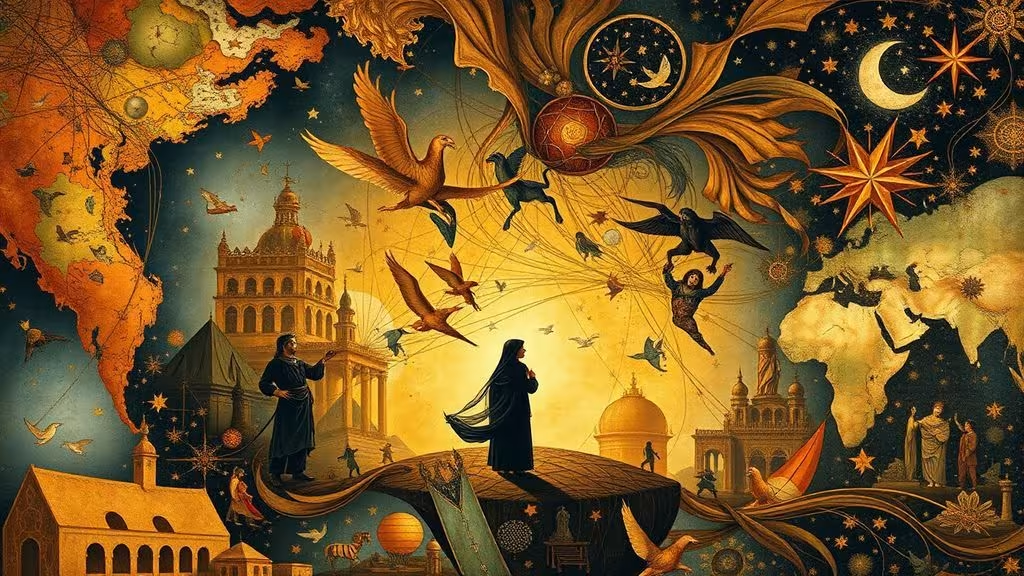
The Arabian Nights isn't a book penned by one genius. Think of it as a living library, growing and changing over centuries. It absorbed stories from India, Persia, and the bustling markets of Baghdad and Cairo, eventually reaching the salons of 18th-century Paris. The very title, "The Truth Behind the Arabian Nights," suggests a quest, an archaeological dig through layers of text to unearth how these stories were built and what societies shaped them. It's a journey into how collective memory transforms history into legend and reality into fable. Our journey will trace the genetic path of these tales, using linguistic and historical analysis to reveal how real figures, like the Persian Queen Homāy or the Syrian storyteller Hanna Diyab, played crucial roles.
Scheherazade: Between Royal History and Literary Legend
Scheherazade, the wise narrator who faces the executioner's sword with her words, is the heart of the "Nights." Historians have long debated her existence: was she pure fiction or a reflection of a real woman from the past?
Linguistic Clues: The Name's Meaning
"Scheherazade" has deep Persian roots, dating back to the Sasanian era. In Middle Persian (Pahlavi), the name was "Cehrazad" or "Chehr-zad" [4]. "Cehr" means origin, lineage, or appearance. "Azad" means free, noble, or ancient. So, Scheherazade literally means "of noble origin" or "free-born." This fits how Ibn al-Nadim and al-Mas'udi refer to her, linking her to a vizier's daughter in the original Persian book. The shift from "Chehrazad" to "Scheherazade" (which might mistakenly sound like "born in the city" from "shahr") reflects natural Arabicization and the evolution of the Persian language, but the original root points to nobility and royal lineage.
Homāy Čehrzād: The Historical Queen and Archetype
Ancient Iranian historical texts, like the Zoroastrian Bundahišn and Ferdowsi's Shahnameh, mention a historical/semi-mythical queen with the same name and qualities: Homāy Čehrzād [4]. She was the daughter of King Bahman, who married her father (a tradition in some Zoroastrian interpretations to maintain royal blood purity). Homāy ruled for 30 years after her father's death, a period known for prosperity and wisdom.
Ferdowsi describes Homāy as "wise and learned," strikingly similar to how Scheherazade is introduced, having "read many books of ancient peoples." This strong parallel suggests Scheherazade isn't a mere invention but a literary reimagining of a historical figure deeply etched in the Persian consciousness [4].
From Throne to Bedchamber: A Functional Transformation
Why did Queen Homāy become a vizier's daughter in the "Nights"? This transformation serves the story's dramatic frame. The tale needs a potential victim from outside the immediate royal family to sacrifice for her kin. Making her a vizier's daughter places her in a middle ground: close enough to power for knowledge and audacity, yet vulnerable enough to the king's arbitrary law [5]. This also reflects Indian influences, where the vizier or his daughter often act as wise voices to guide the king.
The Indian Layer: Structural and Ethical Foundations
Before reaching Persia, the roots of these tales ran deep in Indian soil. Comparative studies show that the core structure of the "Nights" — the frame narrative technique — is a distinct Indian innovation [14].
The Frame Narrative: A Storytelling Engine
Ancient Sanskrit literature, like the Mahabharata, Ramayana, and story collections such as "Kathasaritsagara" (Ocean of Story), use complex nested narratives. The most influential model for the "Nights" is "Panchatantra" or "Baital Pachisi" (known in Arabic as "Kalila wa Dimna") [1].
In "Panchatantra," a king asks a sage (Bidpai) to educate his sons, and the sage tells animal fables with moral and political lessons. In the "Nights," Scheherazade plays a similar role, "teaching" King Shahryar through stories to overcome his trauma and become a just and humane ruler [2].
Animal Fables and Practical Wisdom
The Indian influence is clear in early stories, especially "The Tale of the Bull and the Ass," narrated by the vizier (Scheherazade's father) to his daughter to dissuade her from marrying the murderous king [8]. This pattern of animals speaking practical wisdom is purely Indian, similar to Buddhist Jataka Tales [9].
The Indian Roots of Marital Betrayal
Even the core catalyst for the events — the king's discovery of his wife's infidelity — has roots in Indian folk tales [27]. The motif of a king returning from a hunt to find his wife with another man is common in ancient Indian literature, often depicting characters with different ethnic features to emphasize strangeness or barbarity in the old imagination.
The Persian Layer: "Hezar Afsan" and the Bridge to Arabic
The Persian period was the melting pot where Indian elements were refined into a new form: the book "Hezar Afsan" (A Thousand Fables or Tales) [10]. This lost book is the most crucial link in the Nights' evolution.
Early Arab Historians' Testimonies
Strong historical evidence confirms the existence and influence of "Hezar Afsan."
- Al-Mas'udi (d. 956 CE) in his encyclopedic work "Muruj al-Dhahab" explicitly states that "One Thousand and One Nights" is an Arabic translation of a Persian book called "Hezar Afsan." He adds a crucial detail: "its story is like that of the king and the vizier and his daughter and her maid, who are Shirazad and Dinarzad" [4]. This confirms the main characters (Scheherazade, Dinarzade, Shahryar) existed with their Persian names in the version known to Arabs in the 10th century.
- Ibn al-Nadim (d. 995 CE) in "Al-Fihrist" dedicates a section to tales and fables, mentioning "Hezar Afsan" as the first book of its kind. However, as a bookseller and critic, Ibn al-Nadim adds a critical note, calling it "a dull, cold tale." This critique suggests that the original Persian version or its early Arabic translations might have been dry and simple compared to the narrative richness that evolved later in the Abbasid and Mamluk periods.
The Meaning of "Thousand"
The Persian word "Hezar" means "thousand," but its use in the original title didn't necessarily mean exactly 1000. It signified abundance and exaggeration, "many, many tales" [13]. When translated to Arabic, it became "Alf Layla" (A Thousand Nights), with "wa-Layla" (and a Night) added later (perhaps in Egypt) to break the even number, which some folk beliefs considered unlucky, or to emphasize infinity [12].
The Sasanian Element
The story's timeframe is set during the Sasanian kings (226-651 CE). Names like "Shahryar" (meaning "city guardian" or "king") and "Shah Zaman" (king of the age) are typical Sasanian royal titles. This Persianization transformed the tales from an abstract Indian setting to a specific royal court with its protocols and rituals, giving the work an aristocratic external frame [14].
The Arabic Layer (Baghdad): The Golden Age of Narrative
After "Hezar Afsan" was translated into Arabic (likely in the 8th century), the book moved to Baghdad, the capital of the Abbasid Caliphate. Here, it ceased to be a mere translation and began a radical transformation. Arab narrators and compilers didn't just reproduce Persian stories; they infused the book with the spirit of the Abbasid era.
Harun al-Rashid: Between History and Legend
The cycle of stories featuring Harun al-Rashid is a key Abbasid addition [15]. The fifth Abbasid Caliph (786-809 CE) appears as a central character, but he's not the historical statesman and military leader. He's the "legendary Rashid": the vigilant ruler, the adventurous lover who roams Baghdad's streets at night disguised as a merchant to check on his people [16]. This shift reflects a popular longing for the era of strength and prosperity that Rashid's reign represented. In the Nights, Rashid symbolizes poetic justice and power that can intervene at any moment to change people's destinies.
Jafar al-Barmaki: The Vizier and Companion
Rashid's portrayal in the Nights is incomplete without his constant companion, Jafar al-Barmaki [17]. Historically, Jafar ibn Yahya al-Barmaki was an influential and cultured figure, the Caliph's favorite companion until Rashid turned against him in the infamous "Barmaki catastrophe" of 803 CE, leading to his execution [18]. In the "Nights," Jafar escapes this fate, appearing as the voice of reason and wisdom, mediating between the Caliph's whims and reality. His pervasive and positive role (like his detective work in "The Three Apples") might be a form of "literary rehabilitation" by popular memory for the Barmaki family, known for generosity and patronage of literature [18].
Abu Nuwas and Literary Salons
The Abbasid period also introduced stories about the famous poet Abu Nuwas, known for his witty and sometimes licentious poetry. These tales reflect the life of Abbasid "salons": poetry, music, slave girls, and wine. The Nights transform from ancient jinn stories into urban fiction, mirroring the opulent and complex life of Baghdad [21].
The Mamluk Layer (Cairo): The Narrative Explosion
After Baghdad's destruction in 1258 CE by the Mongols, the cultural and political center of the Islamic world shifted to Cairo under the Mamluks. Here, the "Nights" underwent its most significant expansion and transformation, producing what's known as the "Egyptian Recension" [21].
Driving the Expansion: Reaching the Magic Number
During this phase, the title "One Thousand and One Nights" (1001) became binding for scribes. Earlier Syrian versions stopped at 200 or 300 nights. To fill this huge gap, Egyptian scribes ("warraqun") incorporated everything they could find: folk epics, local tales, religious stories, and even anecdotes from classical literature [12].
"Shuttar" and "Ayyar" Literature: Cairo's Gritty Reality
These stories unfold in Old Cairo neighborhoods, showcasing "shuttar" (rogues) literature, depicting clever thieves, tricksters, and marginalized classes [24].
- Ali al-Zibaq: A popular hero who fights corrupt authorities with cunning and intelligence [24].
- Dalila the Crafty: Presents a unique female archetype—a strong woman who manipulates men and power with her wit, carving a place in a strict patriarchal society [24].
- The Hunchback's Tale: A prime example of Mamluk storytelling, where a hunchback's corpse is passed between different communities (Muslim tailor, Jewish doctor, Christian steward), reflecting the cosmopolitan nature of Mamluk society and inter-communal relations [1].
The European Intervention: Antoine Galland and Hanna Diyab
It might shock the casual reader to discover that some of the most globally famous stories associated with the "Nights" — "Aladdin," "Ali Baba," and "Sinbad" (Orphan Stories) — were not in the original ancient Arabic manuscripts. They are "orphan stories" added much later, specifically during the French translation in the 18th century [2].
Antoine Galland and the Quest for More
The French orientalist Antoine Galland began translating an old Syrian manuscript in 1704. The first volumes were a huge success in Europe, creating massive demand for more. But the Syrian manuscript was incomplete. Galland found himself in a dilemma: publishers and readers wanted the rest of the 1001 nights, but the manuscript ended [31].
Hanna Diyab: The Hidden Author of "Aladdin" and "Ali Baba"
In 1709, Galland met a young Syrian Maronite from Aleppo named Hanna Diyab, who had traveled to Paris [32]. According to Galland's memoirs (confirmed by the discovery of Diyab's own memoirs in the Vatican in 1993), Diyab orally narrated several tales to Galland, including "Aladdin and the Magic Lamp" and "Ali Baba and the Forty Thieves" [33].
- Aladdin: Modern analyses suggest Diyab drew inspiration for Aladdin from his own life as an ambitious young Easterner abroad, and from his observations of the opulence of Versailles, blending it with Aleppo's narrative traditions. The story is a product of "Franco-Syrian collaboration" in the 18th century, not a medieval Arabic text [35].
- Ali Baba: Similarly, no Arabic manuscript origin exists for Ali Baba before Galland's translation. It's a gift from Hanna Diyab that became an icon of the book [30].
The Sinbad Cycle: A Separate Work
"Sinbad the Sailor" has a slightly different status. Sinbad's stories existed as a separate literary work, recounting the adventures of Abbasid-era sea merchants, inspired by travelogues like "Wonders of India." Galland (or earlier scribes) integrated this standalone cycle into the "Nights" to increase its volume, even though it originally had no relation to Scheherazade or the frame narrative [36].
Themes in the Tapestry of the Nights
Beyond historical origins, the text is rich with themes reflecting the social and psychological structures of Middle Eastern societies of those eras.
Sexuality and Power (Pederasty and Gender)
Original "Nights" texts (uncensored in modern editions) were very explicit about sexual themes [38]. This openness reflects a literary culture that saw humor and hedonism as part of entertainment. Studies show stories discussing "ghilman" (young boys) as part of social and narrative fabric, especially in Abbasid contexts (like Abu Nuwas's tales) and Mamluk ones. These stories weren't just for titillation but often reflected power dynamics or mocked religious or political figures [39].
The Hidden Agency of Women
Despite the seemingly patriarchal frame (a king killing women), the Nights present powerful female archetypes. Scheherazade herself is the prime example, saving society with her intellect. Within the internal stories, we find proactive, assertive, and sometimes cunning women (like Dalila). This contradiction between the legal/religious reality of women and their dominant presence in popular narrative reflects an implicit recognition of women's power in private and public spheres [5].
Watch the Full Discussion
Sources & References
Key Sources
- One Thousand and One Nights - Wikipedia
- Arabian Nights - A History of 'One Thousand and One Nights' - Pook Press
- HOMĀY ČEHRZĀD - Encyclopaedia Iranica
- Princess Scheherazade: A Melting Pot of 1001 Tales - FormFluent
- XA.Tale of the Bull and the Ass | The Arabian Nights - WordPress.com
- 01 Tale of The Bull and The Ass | PDF | Laughter - Scribd
- Tales from The Thousand and One Nights - Long long time ago
- English language*Arabian Nights ))One Thousand and One Nights
- The Arabian Nights - All 1001 nights Showing 1-12 of 12 - Goodreads
- The Arabian Nights: The Frame Tale - Encyclopedia.com
- The Splendid Sultan - Saudi Aramco World
- Hārūn al-Rashīd | Abbasid Caliph & Legendary Ruler | Britannica
- Ja'far ibn Yahya - Wikipedia
- Downfall of a Family: Who was Jafar? 803 | All Things Medieval - Ruth Johnston
- Eros and the Arabesque: An End to 1001 Nights? | Ronald B. Richardson
- The Adventures of Mercury Ali of Cairo | Arabian Nights Wiki - Fandom
- From History to Fiction: The Tale Told By the King's Steward in the 1001 Nights Oral Tradition Journal
- Ali Baba and the Forty Thieves - Wikipedia
- The Puzzling Inclusion of the French-Syrian Orphans in One Thousand and One Nights - Broncho Blogs
- The 1001 Tales of Hanna Diyab | AramcoWorld
- Hanna Diyab - Wikipedia
- Was Aladdin Based on a Real Person? Here's Why Scholars Are Starting to Think So
- Sindbad the Sailor | Arabian Folktale, Epic Adventures & Literary Character | Britannica
- Tempting Pederasty (Chapter 11) - The Sexual World of the Arabian Nights - Cambridge University Press
- Inexorable Sexuality (Chapter 2) - The Sexual World of the Arabian Nights
View Full Bibliography
- One Thousand and One Nights - Wikipedia
- Arabian Nights - A History of 'One Thousand and One Nights' - Pook Press
- A very short history of One Thousand and One Nights | Blogs & features | Shakespeare's Globe
- HOMĀY ČEHRZĀD - Encyclopaedia Iranica
- Princess Scheherazade: A Melting Pot of 1001 Tales - FormFluent
- Sherazade on Jango Radio | Full Bio, Songs, Videos
- The Earlier History of the Arabian Nights
- XA.Tale of the Bull and the Ass | The Arabian Nights - WordPress.com
- 01 Tale of The Bull and The Ass | PDF | Laughter - Scribd
- Tales from The Thousand and One Nights - Long long time ago
- 1001 Nights: The Origins, Themes, and Global Reach - FairyTales.App
- English language*Arabian Nights ))One Thousand and One Nights
- The Arabian Nights - All 1001 nights Showing 1-12 of 12 - Goodreads
- The Arabian Nights: The Frame Tale - Encyclopedia.com
- The Splendid Sultan - Saudi Aramco World
- Hārūn al-Rashīd | Abbasid Caliph & Legendary Ruler | Britannica
- Ja'far ibn Yahya - Wikipedia
- Downfall of a Family: Who was Jafar? 803 | All Things Medieval - Ruth Johnston
- Is there any confirm that disney's jafar was based on the first POP's jafar : r/PrinceOfPersia
- Harun Al-Rashid: the Fifth and Greatest Abbasid Caliph | Middle East And North Africa
- Eros and the Arabesque: An End to 1001 Nights? | Ronald B. Richardson
- On why the Arabian Nights matters so much to Fantasy: Arabian Fantasy Literature | The Stranger's Bookshelf
- Were the stories in the Arabian Nights actually widely known in Arabia during the Middle Ages? : r/AskHistorians - Reddit
- The Adventures of Mercury Ali of Cairo | Arabian Nights Wiki - Fandom
- Rediscovering Palestine - UC Press E-Books Collection
- The Dark Side of 'The Arabian Nights' – Robert Irwin - Critical Muslim
- From History to Fiction: The Tale Told By the King's Steward in the 1001 Nights Oral Tradition Journal
- The Arabian Nights (New Deluxe Edition) - CDN
- The History of Aladdin
- Ali Baba and the Forty Thieves - Wikipedia
- The Puzzling Inclusion of the French-Syrian Orphans in One Thousand and One Nights - Broncho Blogs
- The 1001 Tales of Hanna Diyab | AramcoWorld
- Hanna Diyab - Wikipedia
- The 1001 Tales of Hanna Diyab - Matthew Teller
- Was Aladdin Based on a Real Person? Here's Why Scholars Are Starting to Think So
- Sindbad the Sailor | Arabian Folktale, Epic Adventures & Literary Character | Britannica
- Sinbad the Sailor - Wikipedia
- Tempting Pederasty (Chapter 11) - The Sexual World of the Arabian Nights - Cambridge University Press
- Inexorable Sexuality (Chapter 2) - The Sexual World of the Arabian Nights
In essence, the "truth" behind the Arabian Nights is that it's a cross-civilizational masterpiece. Scheherazade isn't one woman but the accumulated voice of wisdom across centuries, starting Indian, donning Persian garb, speaking eloquent Arabic, and eventually embracing a global identity in Europe. It's a living text that never stopped growing, a mirror reflecting the hopes, fears, and desires of Middle Eastern peoples for over a thousand years, ultimately becoming a treasure for all humanity. As Scheherazade herself might have said on one of her nights: "And if the story is told, it has earned eternity."