Imagine a world without oxygen. Most of us instantly picture holding our breath, a frantic search for air, a struggle against suffocation. But what if the question wasn't about the air we breathe, but about the very atoms that make up our world? What if, for just five terrifying seconds, every single oxygen atom on Earth simply… ceased to exist? This isn't just a thought experiment; it's a dive into the fundamental fabric of our reality, revealing just how deeply interwoven oxygen is with everything we know.
The implications are far more catastrophic than mere asphyxiation. We're talking about a complete unraveling of our physical world – a literal deconstruction of mountains, oceans, buildings, and even our own bodies. Oxygen isn't just a life-sustaining gas; it's the invisible glue holding together 46.6% of the Earth's crust by weight, 86% of its oceans, and the very chemistry that grants solidity to concrete and prevents metals from fusing together. This isn't about running out of breath; it's about the Earth itself losing its structural integrity in an instant, plunging our planet into an unimaginable apocalypse.
This report, far from focusing on atmospheric oxygen (O2) disappearing, delves into the devastating scenario of atomic oxygen depletion. It’s the difference between merely losing a component of the air and having the foundational building blocks of countless compounds – from water to DNA to the silicon in rocks – vanish without a trace. The consequences, as we’ll explore, are immediate, violent, and would fundamentally reshape our world in a way that goes far beyond any natural disaster we can comprehend.
The Air We Breathe, Gone (Atmospheric & Optical Effects)
The atmosphere we take for granted is about 21% oxygen by volume. If every oxygen atom vanished, this wouldn't just mean a lack of O2; it would mean a catastrophic pressure drop. Imagine suddenly ascending thousands of meters in an instant – that's the equivalent of what the world would experience. The atmospheric pressure would plummet by roughly 21%, from 101.3 kilopascals to about 80 kilopascals, or the pressure found at an altitude of 2,000-2,200 meters. [1]
Barometric Trauma: Your Body's Internal Explosion
This sudden, massive drop in external pressure would create an immediate and violent pressure differential across any enclosed gas-filled space within our bodies. The most immediate, painful effect would be "explosive barotrauma." Your eardrums, for instance, would be violently pushed outwards, leading to instant rupture, excruciating pain, and bleeding [4]. Similarly, if you were to hold your breath, the air trapped in your lungs would expand dramatically, causing your alveoli – the delicate air sacs responsible for gas exchange – to tear apart, leading to fatal internal hemorrhaging [7]. Every air-filled cavity, from sinuses to intestines, would experience this explosive decompression.
The Vanishing Blue: Why the Sky Turns Black
The vibrant blue of our daytime sky is a phenomenon called Rayleigh scattering, where sunlight interacts with gas molecules like nitrogen and oxygen. Oxygen molecules are significant contributors to this scattering. With atomic oxygen gone, roughly 21% of the scattering particles, along with water vapor (which becomes hydrogen gas, as we'll see), would disappear. The result? A dramatic reduction in scattered light. The sky wouldn't be blue; it would turn a deep, dark black, even in broad daylight. The sun would appear as a blindingly bright disk against an utterly dark, star-filled void, much like what astronauts experience in space or high-altitude pilots see above the densest parts of the atmosphere.
Ozone Layer Disintegration: The Earth's Exposed Skin
Our planet's protective shield, the ozone layer, is chemically composed of triatomic oxygen (O3) – an allotrope of oxygen. Without any oxygen atoms, the ozone layer would simply cease to exist. This thin, vital atmospheric blanket absorbs 97-99% of the sun's medium-frequency ultraviolet (UV-B) and high-frequency (UV-C) radiation. In the absence of this shield, within those five seconds, the Earth's surface would be blasted with the full intensity of this deadly radiation. Any exposed skin would suffer immediate, severe sunburn equivalent to years of natural exposure, causing instant DNA damage and photochemical burns [3].
The Earth's Skeleton Crumbles (Structural Collapse)
When we consider oxygen's role, we often forget its chemical importance in holding things together. For materials science and structural integrity, its disappearance is a literal unraveling.
Concrete's Unraveling: Buildings to Dust
Concrete, the most widely used building material globally, relies entirely on the strength and durability of Calcium Silicate Hydrate (C-S-H) compounds, often referred to as "cement glue." The chemical formula for C-S-H includes oxygen atoms in intricate silicate chains that provide concrete its strength. Oxygen acts as a "bridging element," linking calcium ions and silicon. If atomic oxygen vanishes, these C-S-H bonds instantly disintegrate. The silicate chains break down, turning the solid material into a fine dust of elemental calcium, free silicon, and other original components [11]. Skyscrapers, dams, bridges – every concrete structure on Earth would not "fall"; it would instantaneously pulverize into a cloud of fine dust, releasing billions of cubic meters of water (now hydrogen gas) from dams and leaving behind only a shapeless, powdery residue [13].
Metals Fused: The Phenomenon of Cold Welding
Modern machinery, vehicles, and aircraft rely on the fact that metal surfaces don't typically bond when they touch. This is because metals naturally form a thin, protective layer of metal oxides when exposed to oxygen. This oxide layer acts as a barrier, preventing the atoms of one metal from interacting with those of another. In the absence of atomic oxygen, this oxide layer would instantly vanish. Metal surfaces would become atomically "clean" and highly reactive. Any two metal surfaces in contact – piston rings in an engine, gears in a gearbox, even control surfaces on an airplane – would spontaneously bond, fusing into a single, solid piece of metal. This phenomenon, known as "cold welding," is common in the vacuum of space [14]. Engines would seize, wheels would lock, and aircraft controls would freeze, turning planes into uncontrolled metallic projectiles plummeting to Earth.
Oceans Explode (Hydrological Catastrophe)
Water (H2O) is the lifeblood of Earth, and oxygen constitutes a staggering 88.8% of its mass. Its disappearance would lead to the most dramatic physical transformation.
Water to Hydrogen Gas: The Ultimate Phase Transition
If the oxygen atom in every H2O molecule vanished, what would remain are just the two hydrogen atoms. Hydrogen at standard room temperature and atmospheric pressure is not a liquid; it's a highly volatile gas [19]. Instantly, all the water on Earth – every ocean, river, cloud, and underground reservoir – would undergo a catastrophic phase transition, turning from liquid into free hydrogen gas. This isn't evaporation; it's an immediate chemical decomposition.
The Great Expansion: Oceans Becoming Shockwaves
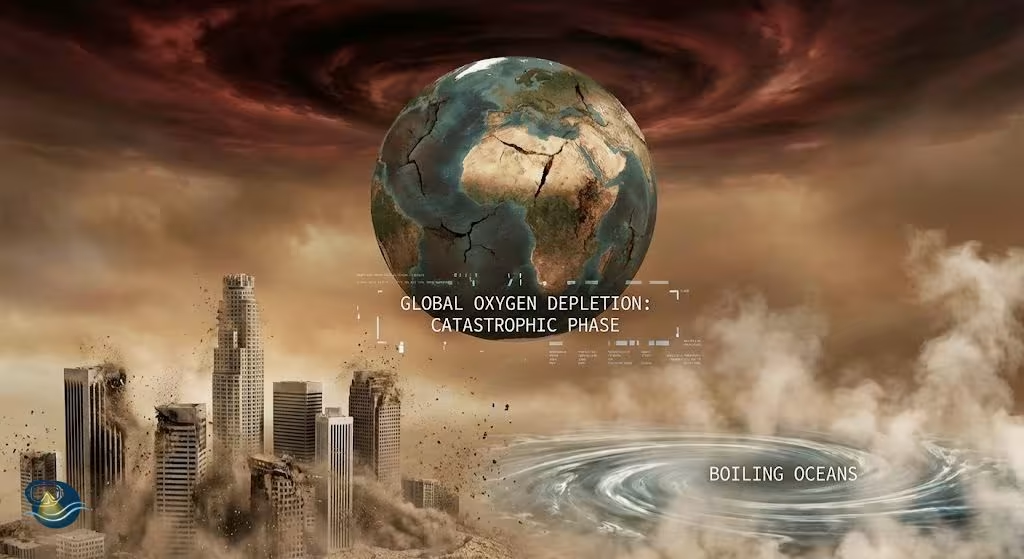
Hydrogen gas occupies vastly more space than liquid water. Physically, hydrogen gas expands by a factor of approximately 1800-2000 times the volume of the original water [17]. The oceans wouldn't "boil away" slowly; they would undergo an explosive expansion, generating colossal shockwaves as billions of cubic kilometers of liquid abruptly transform into an immense volume of hydrogen gas. This sudden, violent expansion would tear apart coastal areas and inland waterways. The extremely light hydrogen gas would then rapidly escape Earth's gravity and dissipate into space, leaving a dry, barren planet.
Buried Waters Unleashed: Underground Cataclysms
Reservoirs behind dams (now dust), and vast quantities of underground water, would also instantly convert into highly pressurized hydrogen gas. This gas, unable to be contained by the now-crumbling geological structures, would explode violently outwards from within the Earth's crust. This would contribute to further widespread destruction, tearing apart what remained of the planetary surface, creating immense new chasms, and triggering unprecedented geological instability.
The Planet Itself Fractures (Geological Impact)
Our perception of Earth as a solid, unyielding sphere is fundamentally reliant on oxygen's presence. Remove it, and the very ground beneath our feet would give way.
The Crust's Oxygen Foundation: A Disintegrating Shell
The Earth's crust is primarily composed of silicate minerals (like SiO4), along with various oxides such as aluminum oxide (Al2O3), iron oxide (Fe2O3), and calcium carbonate (CaCO3). Oxygen atoms are the foundational elements in these compounds, making up approximately 46.6% of the crust's weight and an astonishing 90% of its volume, thanks to their larger atomic size [5]. Without oxygen, these complex silicate networks and oxide structures would instantly collapse.
Freefall into Dust: Mountains to Powder, Continents to Churning Dust
The chemical bonds that give rocks their cohesion and strength would vanish. Mountains, plains, and even the ocean floor (now dry) would disintegrate into an ultra-fine, unbonded powder – a "fluidized dust." The Earth itself would lose roughly half its mass. Any object on the surface – people, cars, trees – would suddenly find itself significantly denser than the surrounding disintegrated crust. This would lead to a phenomenon akin to "freefall" or sinking. We wouldn't just be standing on crumbling ground; we'd be sinking into a churning, superfine dust storm, plummeting towards the Earth's now less dense core [20].
The End of Life as We Know It (Biological Consequences)
It's a common misconception that humans could simply "hold their breath" if oxygen disappeared. The reality of atomic oxygen vanishing means the very molecular framework of life would unravel.
Cellular Explosions: Life's Inner Cataclysm
Human bodies, like most living organisms, are 60-70% water. Inside every cell, water molecules are constantly at work. If the oxygen atom in every water molecule (H2O) disappeared, this intracellular water would instantly convert into hydrogen gas. Gaseous hydrogen occupies thousands of times more volume than liquid water. This sudden and massive internal expansion would cause every cell in every living organism to explosively rupture, a process known as cellular lysis [2]. Humans and animals wouldn't suffocate; they would violently swell and burst from the inside out, turning into a cloud of hydrogen gas and other residual elements.
Molecular Disintegration: DNA's Untwisting Strands
Beyond water, oxygen atoms are integral components of all major biological macromolecules. DNA, the blueprint of life, relies on deoxyribose sugar and phosphate groups, both of which contain oxygen. Proteins, carbohydrates, and lipids – the building blocks and fuel of all life – are all rich in oxygen. Without these oxygen atoms, the fundamental chemical bonds that give these molecules their structure and function would instantly break. DNA strands would untwist and fragment, proteins would denature into their constituent atoms, and the entire molecular scaffolding of life would disintegrate. This means life would cease at the most fundamental, atomic level; there would be no biological processes, no cellular integrity, just a rapid, irreversible molecular breakdown.
Plants to Dust: The Vanishing Forests
Plants, which rely on cellulose (C6H10O5) for their structural integrity, would also face immediate collapse. Cellulose is packed with oxygen atoms. If these vanish, the sturdy structures of trees and plants would instantly turn into a fine dust of carbon and hydrogen. Forests would not wither; they would simply vanish, leaving behind only a powdery residue where majestic trees once stood. The entire biosphere, from microscopic bacteria to towering sequoias, would be eradicated in an instant.
The Recombination: A Planetary Inferno (The "Return" Scenario)
What if, after those five apocalyptic seconds, the oxygen atoms suddenly reappeared? One might hope for a reversal of fortune, but the reality would be far more terrifying.
Hydrogen's Fiery Reunion with Oxygen
In the preceding five seconds, all of Earth's water would have transformed into free hydrogen gas, much of which would still be present in the atmosphere, alongside the hydrogen from exploded cells and pulverized plants. When the oxygen atoms suddenly return, the atmosphere would be filled with an incredibly volatile mixture of hydrogen and oxygen gases. Hydrogen is highly flammable, and its reaction with oxygen (2H2 + O2 → 2H2O) is intensely exothermic, releasing a tremendous amount of energy.
A World Remade by Fire: The Ultimate Explosion
Any spark – and there would be countless sparks from the friction of collapsing debris, geological shifts, and perhaps even lightning – would instantly ignite this planetary-scale mixture. The result would be an unimaginably vast, instantaneous explosion. Calculations suggest this "recombination" explosion would be equivalent to trillions of tons of TNT, covering the entire planet's surface [24]. The Earth's remaining crust would be vaporized or melted, transforming the planet into a molten, fiery ball, not unlike the early stages of a star's formation. It would be a catastrophic reset, wiping away any trace of the world that once was, ending not with a whimper, but with the loudest bang imaginable.
Watch the Full Discussion
Sources & References
Key Sources
- What would happen if oxygen were to disappear for 5 seconds?
- What Does Losing 5-Second Oxygen Means for Earth? | YourStory
- What if the world lost oxygen for five seconds?
- Ear barotrauma: Causes, treatment, and recovery time - Medical News Today
- Calcium silicate hydrate | chemical compound - Britannica
- science based - Effects of being briefly exposed to a zero air...
- Here's What Will Happen if Our Entire Planet Loses Oxygen for Just...
- Here's What Will Happen if Our Entire Planet Loses Oxygen for Just... (GreenMatters)
- In the vacuum, two clean pieces of metal, can WELD spontaneously...
- Expansion ratio – Wikipedia
- What would happen if oxygen were to briefly disappear from Earth's atmosphere...
- Is it true that if there is no oxygen on the Earth for five minutes...
- What If The World Lost Oxygen For 5 Seconds? - YouTube
View Full Bibliography
- What would happen if oxygen were to disappear for 5 seconds?
- What Does Losing 5-Second Oxygen Means for Earth? | YourStory
- What if the world lost oxygen for five seconds?
- Ear barotrauma: Causes, treatment, and recovery time - Medical News Today
- Ear Barotrauma | Cedars-Sinai
- What would happen if oxygen disappeared for five seconds? | The Independent
- science based - Effects of being briefly exposed to a zero air...
- The Catastrophic Effects of Earth Losing Oxygen for 5 Seconds | by Jason Toh | Write A Catalyst | Medium
- Calcium silicate hydrate | chemical compound - Britannica
- Calcium silicate hydrate – Knowledge and References - Taylor & Francis
- Here's What Will Happen if Our Entire Planet Loses Oxygen for Just...
- What would happen if oxygen disappeared for five seconds? | The Independent (text fragment)
- Here's What Will Happen if Our Entire Planet Loses Oxygen for Just... (GreenMatters text fragment)
- In the vacuum, two clean pieces of metal, can WELD spontaneously...
- The Intriguing Phenomenon of Cold Welding in Space: How Metals Bond Without Heat
- Cold Welding Explained | Fractory
- Expansion ratio – Wikipedia
- what is volume of produced gases in water electrolysis [closed] - Chemistry Stack Exchange
- What would happen if oxygen were to briefly disappear from Earth's atmosphere...
- Is it true that if there is no oxygen on the Earth for five minutes...
- What would happen if oxygen were to briefly disappear from Earth's atmosphere, then reappear?
- Can hydrogen and oxygen gasses be turned back into water? - Chemistry Stack Exchange
- Making water from hydrogen and oxygen
- What If The World Lost Oxygen For 5 Seconds? - YouTube
The thought experiment of oxygen disappearing for five seconds reveals a truth far more profound than simple suffocation. It exposes oxygen as the silent, omnipresent "matrix" holding our entire physical reality together. From the blue of our sky to the solidity of our buildings, the liquidity of our oceans, the stability of our planet's crust, and the very structure of life itself – everything is intricately dependent on those tiny, ubiquitous oxygen atoms. Their instantaneous disappearance wouldn't be an inconvenience; it would be a complete and utter annihilation, reducing our complex world to a chaotic swirl of dust and gas, followed by a cataclysmic inferno upon their hypothetical return. It's a stark reminder of the delicate, interconnected chemical balance that makes our Earth, and life on it, possible.