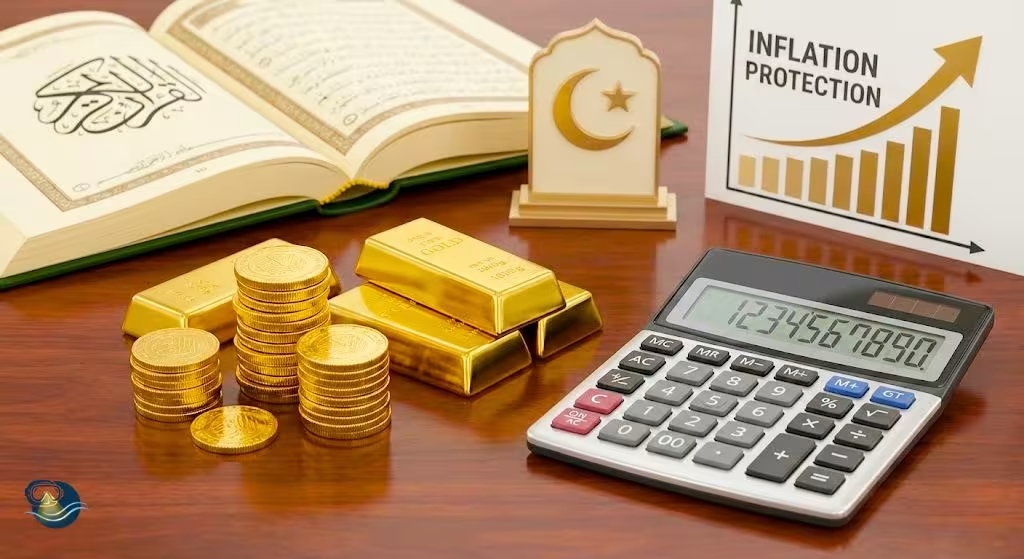
Imagine waking up one day to find your hard-earned savings are worth less than they were yesterday. Not because of a market crash, but because a silent, invisible force has been steadily eroding their power. This force is inflation, and it's been stealing wealth for centuries. It's a concept often misunderstood, yet it impacts every single one of us, from the price of your daily bread to the stability of entire nations. Understanding inflation isn't just for economists; it's a vital tool for personal financial survival in an ever-changing world.
What Exactly is Inflation? More Than Just Rising Prices
Inflation isn't just a temporary jump in the price of one item. It’s a persistent, widespread increase in the general price level of a broad basket of goods and services across the economy. Think of it this way: temporary price hikes aren't inflation; its defining trait is its ongoing nature[1]. It shows an imbalance between the prices of goods and services, and the cost of the resources used to produce them, like wages and profits[1]. The most significant impact of inflation on individuals is the erosion of their money's purchasing power. A unit of currency buys fewer goods and services than it did before[1]. For example, if a loaf of bread goes from $1.00 to $1.05 in a year, that's a 5% inflation rate, meaning your dollar buys 5% less bread. This idea links the abstract economic term to its real-world effect on your daily life. It’s also important to tell inflation (rising prices) apart from deflation (falling prices). While a moderate, steady inflation rate (around 2%) is often seen as healthy for an economy, encouraging spending and investment rather than hoarding cash, uncontrolled inflation can be devastating[3].
The Invisible Measure: Unpacking the CPI
The most common tool for tracking inflation is the Consumer Price Index (CPI)[4]. It measures the average change over time in the prices paid by urban consumers for a representative “basket” of consumer goods and services[5]. This carefully chosen basket is designed to reflect typical household spending. It includes major groups like food and beverages, housing, apparel, transportation, medical care, and education[5]. In the US, for instance, the Bureau of Labor Statistics (BLS) uses detailed spending data from thousands of households to determine the items and their weight in the basket[6]. The inflation rate is calculated as the percentage change in the CPI from one period to another (monthly or annually)[7]. Policymakers often focus on “core CPI,” which excludes volatile food and energy prices, to get a clearer picture of underlying long-term inflation trends. This is because food and energy prices can be swayed by temporary factors like weather or geopolitical events, which might hide ongoing economic pressures[8]. However, the CPI isn't perfect. It faces challenges like “substitution bias” (where consumers switch to cheaper alternatives, which the fixed basket might not immediately catch) and accounting for quality improvements over time[9].
The Engine of Rising Costs: Understanding Inflation's Causes
Inflation isn't a single phenomenon; it’s driven by several factors, often working together.
Demand-Pull Inflation
This happens when total demand for goods and services outstrips the economy's ability to produce them. It's often described as “too much money chasing too few goods”[10]. It can be caused by an increased money supply, government spending, or expanding consumer credit[10]. When demand grows faster than supply chains can respond, prices rise[11].
Cost-Push Inflation
This type emerges from higher production costs, forcing businesses to raise prices to protect their profit margins. Key drivers include rising raw material prices (like oil), increased wages, or supply chain disruptions[12]. The oil shocks of the 1970s are a classic example of cost-push inflation[13].
Built-in Inflation
This type is driven by expectations. When workers expect prices to rise, they demand higher wages. To cover these increased labor costs, companies, in turn, raise their prices, creating a “wage-price spiral” that perpetuates itself[11]. This shows that inflation can be as much a psychological phenomenon as a monetary one. These three main causes of inflation aren't isolated; they form a dynamic, interconnected system. For example, a government stimulus program might lead to demand-pull inflation, increasing consumer spending. This heightened demand puts pressure on supply chains and raw material prices, causing cost-push inflation. Then, as consumers and workers see prices rising everywhere, they start expecting more increases, leading to built-in inflation[11]. What starts as a policy-driven demand shock can evolve into a persistent, self-fulfilling inflationary cycle that is hard to break.
A Global History of Devalued Currencies
The practice of devaluing currency to meet state needs is ancient, even if the term “inflation” is modern.
Ancient Roots: Coin Clipping in the Roman Empire
The Roman Empire offers one of the best early documented examples of inflation, driven not by a printing press, but by currency debasement[14]. Roman emperors, facing huge military and bureaucratic costs, would melt down existing silver coins (like the denarius), mix the silver with cheaper base metals (like copper), and mint more coins. The silver content of the denarius dropped from about 95% under Augustus to just 0.5% by 268 AD[14]. This huge increase in the amount of currency in circulation, with each coin having less intrinsic value, led to soaring prices. By the late third century, prices had risen by 1,000%[14]. This hyperinflation destroyed trust in the currency, led to bartering, severe economic disruption, and oppressive taxes, ultimately contributing to the alienation of the population and the weakening of the Western Roman Empire[14].
The Price Revolution: New World Treasure Reshapes Europe
In the 16th and 17th centuries, Europe experienced a long period of high inflation known as the “Price Revolution”[15]. Prices rose sixfold over 150 years[16]. The primary driver was the massive influx of gold and silver from the Americas (especially from mines in Peru and Mexico) into Spain and then across Europe[16]. This led to a huge increase in the money supply on the continent. This event largely proved the quantity theory of money, which posits that when the money supply grows faster than the real output of goods and services, prices will rise[17]. With more money available, people had greater purchasing power, leading to increased demand against a relatively fixed supply of goods, thus driving prices higher[18].
Eras of Hyperinflation: Weimar Republic and Zimbabwe
These cautionary tales highlight extreme inflation. The Weimar Republic (Germany, 1921-1923) faced a perfect storm: massive WWI reparations, French occupation of the Ruhr, and the German government printing vast amounts of money to pay striking workers and finance its deficit[19]. The currency collapsed entirely. A loaf of bread costing 250 marks in January 1923 cost 200 billion marks by November 1923[19]. People used stacks of worthless banknotes as wallpaper or fuel[20]. This hyperinflation wiped out middle-class savings, created widespread social chaos, and fueled political extremism, contributing to the instability of the Republic and the eventual rise of the Nazi party[20]. Similarly, Zimbabwe (2000s) experienced hyperinflation due to a disastrous mix of economic policies, including chaotic land reforms that crippled agricultural output (a massive supply shock), international sanctions, and the central bank printing money uncontrollably to fund government spending and corruption[21]. The crisis reached a point where the government issued a 100 trillion dollar banknote, and prices doubled every 24 hours at its peak[22]. The crisis ended only when the government abandoned its currency and allowed transactions in foreign currencies like the US dollar, effectively “dollarizing” the economy[23]. These historical patterns show that high inflation often precedes situations where governments face immense financial pressures they cannot or will not meet through legitimate taxation or borrowing. This reveals that severe inflation is not just an abstract economic phenomenon but a political one – often a symptom of a state living beyond its means and using currency debasement as a hidden tax on its citizens.
The Great Inflation of the 1970s
From approximately 1965 to 1982, the industrialized world experienced a prolonged period of high inflation, known as the “Great Inflation”[13]. This wasn't hyperinflation, but it was driven by a convergence of factors. The collapse of the Bretton Woods system in 1971 severed the dollar’s last link to gold, ushering in an era of fiat currencies[13]. This combined with expansive monetary and fiscal policies aimed at achieving full employment (based on a misunderstanding of the Phillips Curve) and two major oil shocks in 1973 and 1979 (cost-push inflation)[13]. This failure to control inflation led to a fundamental rethinking of monetary policy. The modern consensus established that a central bank’s primary goal must be price stability, and maintaining credibility is paramount for anchoring inflation expectations[24].
The Real Cost: Inflation's Long-Term Impacts
Inflation's effects extend far beyond your wallet.
Impact on Savers and Fixed Income Earners
Inflation particularly harms individuals who hold their wealth in cash or low-interest savings accounts. The real value of these savings diminishes over time. A 3% inflation rate, for instance, reduces the actual purchasing power of $10,000 in savings to $9,700 after just one year[25]. Retirees, pensioners, and workers whose wages don't keep pace with inflation suffer a decline in their living standards. Their fixed income buys less and less each year, potentially eroding the middle class[7].
Economic Distortions: Investment, Debt, and Wealth Redistribution
High and unpredictable inflation creates economic uncertainty, making it hard for businesses to plan for the future. This discourages long-term investment and can slow economic growth[26]. Inflation also randomly redistributes wealth. Debtors benefit at the expense of creditors, as they repay loans with money that is worth less than what they borrowed. Asset owners benefit as real assets (like real estate or commodities) tend to see their prices rise with inflation, while those holding primarily cash or fixed-income assets lose out. High local inflation makes a country's exports more expensive and less competitive, while imports become cheaper. This can harm the balance of payments and lead to currency devaluation.
Social and Political Instability
The economic pain and sense of injustice caused by inflation can lead to widespread social discontent, protests, and strikes[27]. As seen in the Weimar Republic, severe inflation creates fertile ground for political extremism. When key institutions fail to resolve the crisis, the public may turn to radical alternatives promising easy solutions[28]. The instability caused by inflation can lead to further economic mismanagement, as weak or populist governments resort to seemingly easy but ultimately destructive policies like price controls (which create shortages) or printing more money to fund welfare. These actions further harm the economy and erode trust, worsening the inflationary spiral.
Building Your Financial Fortress: Personal Strategies
While individuals cannot control macro-economic policy, they can achieve financial resilience through proactive education, disciplined financial management, and a diversified investment approach.
Mastering Cash Flow and Strategic Debt Management
Your first line of defense is understanding and managing your personal finances. This means creating a detailed budget to track income and expenses, identifying areas to cut unnecessary spending, and prioritizing needs over wants[29]. High-interest debt, especially credit cards, is a major liability during inflationary periods. Prioritize aggressively paying down high-interest, variable-rate debts using methods like the “debt avalanche” (highest interest first) or “debt snowball” (smallest balance first)[30]. Consider refinancing variable-rate loans (like mortgages) into fixed-rate loans to lock in borrowing costs before interest rates rise further in response to inflation.
Investing in Tangible Assets: Real Estate and Precious Metals
Historically, real estate has been a strong hedge against inflation. Property values and rental income tend to rise with the general price level[31]. Gold is a classic “safe haven” asset. It’s a physical store of value not tied to any government’s fiscal policy. During times of economic uncertainty and currency debasement, investors often flock to gold, driving its price up[32].
Navigating Financial Markets: Stocks, TIPS, and Diversification
Not all stocks are equal. The best performers during inflation are typically companies with strong pricing power – those that can pass on higher costs to customers without losing business. This often includes companies in essential sectors like consumer staples, healthcare, and energy[33]. Treasury Inflation-Protected Securities (TIPS) are government bonds specifically designed to protect against inflation. Their principal value adjusts upward with the CPI, ensuring that both the principal and interest payments retain their real value. They offer direct, guaranteed protection[34]. Investing in a broad basket of commodities (oil, industrial metals, agricultural products) can also be a direct hedge, as inflation is often characterized by rising commodity prices themselves[35]. The core principle for resilience is diversification. A diversified portfolio containing a mix of stocks, bonds (including TIPS), real estate, and commodities is the most resilient strategy[36].
Boosting Your Earning Power: Investing in Yourself
The most effective long-term strategy is to ensure your income grows faster than the inflation rate. This means continuous learning, acquiring new skills, and advancing in your career. Developing a side hustle, freelancing, or finding other ways to generate additional income provides a crucial buffer. If your primary salary doesn't keep pace with rising costs, an extra income stream can bridge the gap. Protecting wealth from inflation isn't a “set it and forget it” process. It requires a fundamental shift from a passive saver mindset to an active investor and manager. Simply holding cash guarantees a loss of real value[25]. Therefore, individuals must actively manage their finances. This includes effective spending control through budgeting, active management of liabilities by paying down bad debts, actively seeking growth through a diversified asset portfolio, and diligently boosting personal income. Financial resilience in an inflationary world is an ongoing process of strategic decision-making, not a one-time purchase of a “magic” asset.
The lesson is clear: understanding inflation isn't just an academic exercise; it's essential for financial success in a constantly changing world. Imagine yourself now armed with the knowledge and strategies to transform from a passive victim of economic erosion into an active architect of your secure financial future. Don't let the silent thief steal your wealth; defend it wisely.